The purpose of the African Women in Cinema Blog is to provide a space to discuss diverse topics relating to African women in cinema--filmmakers, actors, producers, and all film professionals. The blog is a public forum of the Centre for the Study and Research of African Women in Cinema.

Le Blog sur les femmes africaines dans le cinéma est un espace pour l'échange d'informations concernant les réalisatrices, comédiennes, productrices, critiques et toutes professionnelles dans ce domaine. Ceci sert de forum public du Centre pour l'étude et la recherche des femmes africaines dans le cinémas.

ABOUT THE BLOGGER

My photo
Director/Directrice, Centre for the Study and Research of African Women in Cinema | Centre pour l'étude et la recherche des femmes africaines dans le cinéma

Translate

Search This Blog

Showing posts with label Djibouti. Show all posts

10 September 2022

Souad Houssein. - Expert en cinéma des pays d'Afrique francophone / Specialist in the cinemas of Francophone African countries - Interview par/by Acafou Zacharie Diaspora News Sept 2022

Souad Houssein
Expert en cinéma des pays d'Afrique francophone / Specialist in the cinemas of Francophone African countries
Interview par/by Acafou Zacharie - Diaspora News. Sept 2022 

Français ci-après

During her long, nearly 25-year career with the International Organization of the Francophone (OF), Madame Souad Houssein, Franco-Djiboutian, specialist in the cinemas of Francophonie African countries, has led and coordinated projects for the development and promotion of cinemas of the countries of the South. Her mission is to manage a funding mechanism for aid in film production (Fonds image de la Francophonie), to support the development of the capacities of professionals and to contribute to improving the visibility of the films that are financed. With a strong track record, she recently embarked upon a vast project: the creation of a pan-African audiovisual and cinema observatory (OPAC). 


Diaspora-News: You have built most of your career on the development of cinema, specifically of African countries. Where does your passion for cinema come from and your desire to work towards its development ?


I am one of those people who find their passion and their cause through their profession. Over the years, I discovered that passion took on the colors of activism. I think that this commitment comes from the context of financial austerity in which African cinema found itself at the time, in the 2000s, and which lasted for many years. It is in this context, uncertain and arduous for professionals, constrained in their artistic activity, that shaped this desire to contribute to the development of this sector. An area which is highly important and strategic for a continent which has long been condemned to live through the culture of another. Moreover, I knew that it would be possible to continue my journey because we can all work at our own level for the development of African cinema. To the extent that the development of the cinematographic industry is the fruit of the combined efforts of the precepts of those concerned: the States, the private institutions, organizations, foundations, donors, civil society. For my part, I have always wanted to be engaged in one way or another towards the empowerment and professionalization of African cinema.


D-N: How did the Pan-African Observatory Project for audiovisual and cinema (OPAC) come into being? Could you highlight the main points?


S.H.: It has been nearly five years since the idea of creating a Pan-African Audiovisual and Cinema Observatory germinated in my mind, an observatory which, like the European Audiovisual Observatory (https://www.obs.coe.int/fr/web/observatoire/home), could provide a better understanding of the realities, potentialities and trends of the African moving-image markets continent-wide. However, the Covid-19 pandemic has delayed the schedule for this project, as with many other projects. Finally, it was not until 2022 that I decided to engage in this adventure in cooperation with my partners: Ms. Marie-Paule Babli, lawyer, Mr. Jean Cressant, audiovisual and cinema specialist, and Mr. Servais Locko, multidisciplinary manager.


To describe the project, I would say that the Pan-African Audiovisual and Cinema Observatory (OPAC) is a tool for sustainable cultural development whose mission will be to collect, select, process, analyze and restore relevant data on the cinema and audiovisual markets of the 55 African countries. The OPAC, through its digital platform, will provide information and data, available for online consultation (free or paid). The Observatory aims to serve in particular as a tool to facilitate decision-making in order to provide a better understanding, especially, of the evolution, trends, production, distribution and broadcasting activities of the cinematographic and audiovisual industries in African countries. In the long run, its purpose is to contribute to the economic growth of the African audiovisual sector by attracting private and public capital and encouraging States to put in place policies favorable to the development of an African moving image industry. The data collected will also make it possible to guide the direction of training of personnel interested in this sector of activity. We are convinced that the OPAC will be able to act as an indicator and contribute to a radical change in the manner in which this sector is appreciated--though having many strengths, it is still considered to be risky and budget-consuming.


D-N: Madame Houssein, why create an observatory project now? Why is it necessary?


S.M.: It is true that there are several ways to increase the economic potential of a sector, our response and our contribution is situated at the level of "access to information" which is a crucial prerequisite for all sustained investments. To us it seemed pertinent to concentrate on the "Observatory" response, in order to contribute to breaking down the barriers and the roadblocks which very often penalize this industry said to be “costly” and uncertain. It is also true that neither the quality of a work, nor the experience of a director can guarantee the success of a cinematographic work or a television series.


Moreover, according to the study by UNESCO in 2021, entitled "The African Film Industry: trends, challenges and opportunities for growth" [https://en.unesco.org/creativity/publications/african-film-industry-trends-challenges], in spite of the progress of the African cinematographic and audiovisual sectors, they remain on the whole under-utilized or even untapped. This study made it possible to have an idea of the overall African cinema and audiovisual situation and to have access to regional and national mappings of African cinema. This edifying information has changed our perception of these sectors, by rendering them their own realities, showing their real significance and their own perspectives of their evolution. It is a rich source of information and a precursory in the implementation of an observatory.


For me, the context for laying the foundations of an observatory is favorable because of the material itself. In fact, culture is a strategic industry economically as well as in terms of job opportunities, its benefits are undeniable, particularly in terms of economic aspirations for young people. Moreover, I think that the current period is opportune because African cinema is in full emergence and an observatory could serve as a catalyst accelerating its evolution, and finally the public mind set is ready to receive images coming from Africa. According to the Pan-African Federation of Filmmakers (FEPACI), African cinema has a wide margin of progress. In fact, FEPACI expects that this sector could bring in nearly 20 million euros in revenue per year in the future and generate around 20 million jobs. Indeed, the cultural and creative sectors are key drivers for the economies of all countries and are among the areas experiencing the fastest growth. Furthermore, the cinema and audiovisual sectors have an additional advantage, which is its high job-creating potential. These employment opportunities for African youth are all the more invaluable for us since, according to the United Nations, the under-25 age group will experience strong growth by 2050 and will reach 1.24 billion people, 50% of the total population of the African continent. Finally, even if all African countries do not have support structures for the cinema and audiovisual sector and are far from actually being some kind of industry, African production has nonetheless attained a certain maturity and know-how which have contributed to an increase in audience within and outside the continent, primarily, due to digital platforms.


Moving-image production in Africa, which is now strong both quantitatively and qualitatively, is gaining recognition, being sought after, welcomed, and is now internationalized, due in particular to festivals and digital platforms. As a further matter, within the reach of a click, it has brought to the forefront a cinematographic and audiovisual diversity never achieved before. It is also on this continent that the 2nd cinematic power in the world, Nigeria, after India and before the United States, is found. The evolution of attitudes has come a long way, breaking down the last psychological barriers which still yesterday could hinder African cinema’s push towards the international landscape. African cinema is no longer considered a UFO or a folkloric curiosity, it is a creation on its own merits that has taken its place in the world market. Today audiences around the world are ready to see and enjoy films where, for example, the hero and the entire cast are of African origin, as was demonstrated by the film entitled 'Black Panther' made in 2018, which generated millions of dollars globally in a few weeks. Finally, civil society has also made worthwhile contributions to the building of African cinema, both those from Africa or from the diaspora. For instance, the two African pavilions at the Cannes Film Festival, which for the past two years have been dedicated to the promotion of African cinema, allowing professionals to establish business relationships, it's a sign! And both, [she adds with a smile], are run by women from the African diaspora. It is for all these reasons that we have decided to opt for the "observatory" solution and the creation of a digital platform whose purpose is to provide the most reliable data possible in order to encourage all structures to invest in these sectors. This is what we are proposing.


D-N: What is your perception of African cinema in light of the digital revolution?


S.H.: It is a fact that cinematographic and audio-visual creation in Africa has become democratized and new digital technologies have played a major role in it, both in terms of production or distribution. Similarly, African film and audiovisual production has become internationalized. The advent of digital platforms has been a real developer of cinematographic talent for Africa, which is still poorly equipped with cinemas houses. It has been a godsend. It is the new digital technologies that have allowed this qualitative leap and this intense enthusiasm by young people for these métiers considered yesterday as elitist. The digital has made it possible to produce more, to have better experiences, and to be more visible. It has been a means to develop talent, proficiency, to stimulate competition. To the extent that, having emerged from a certain marginalization, African cinema is increasingly exposed to creative experiences on a global scale; and therefore is called upon to develop more, to structure itself while at the same time attracting young people who have a desire to share its vision of the world through cinema and the audiovisual.

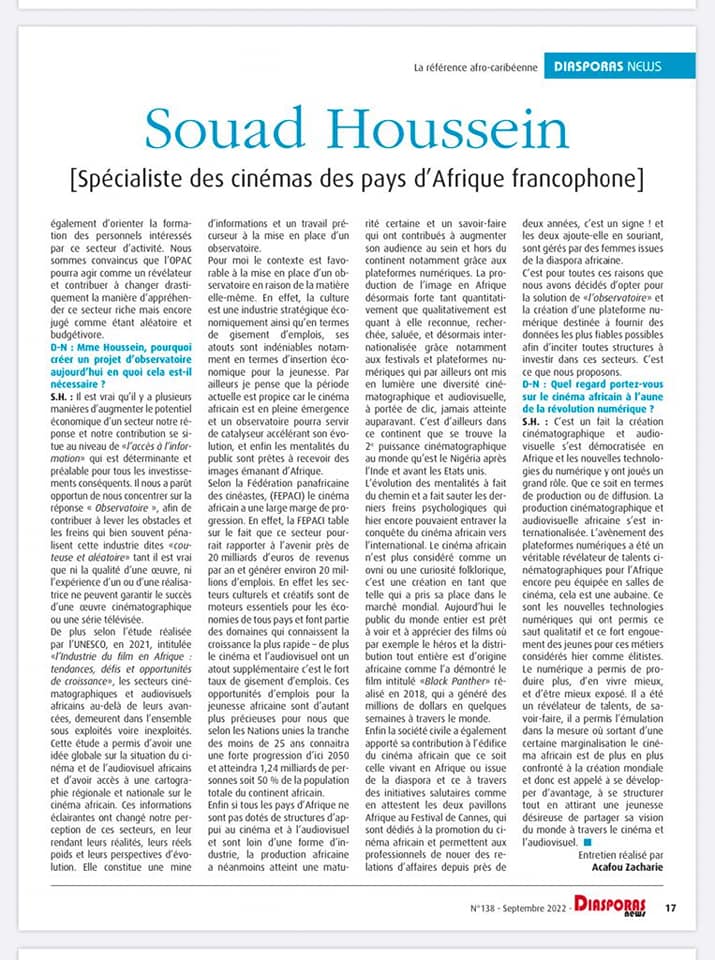
Translation from French by Beti Ellerson


25 February 2020

Festival Films Femmes Afrique 2020 - Lula Ali Ismaïl: Dhalinyaro

Lula Ali Ismaïl
Dhalinyaro 
Djibouti - 2019 - 90 min - Fiction


Description

Trois visages de jeunes femmes : Asma, Hibo et Deka. Toutes trois fréquentent le même lycée, à Djibouti. Asma vient d’une famille pauvre mais sa mère rêve pour elle d’une carrière de médecin. Hibo est d’une famille aisée et habite dans les beaux quartiers. Deka est issue de la classe moyenne. Sa mère, divorcée, élève seule ses quatre enfants. Pour Deka, l’école passe au second plan. Elle fréquente un homme plus âgé qu’elle, Youssouf. Asma, Deka et Hibo adorent leur professeur de philosophie, Zahra qui donne l’impression d’une totale liberté de vie et de pensée. Certaines élèves sont habillées en hijab, d’autres en jean moulant ou en boubou traditionnel. La cour de récréation bourdonne de conversations en arabe, en somali, en afar, et en français.

Three faces of young women: Asma, Hibo and Deka. All three attend the same high school in Djibouti. Asma comes from a modest family, but her mother dreams of a career for her as a doctor. Hibo is from a wealthy family and lives in a beautiful neighborhood. Deka is from the middle class. Her divorced mother raises her four children alone. For Deka, school is not a priority. She's dating an older man, Youssouf. Asma, Deka and Hibo adore their philosophy teacher, Zahra, who gives the impression of complete freedom of life and thought. Some students are dressed in hijab, others in skinny jeans or traditional boubou. The playground is buzzing with conversations in Arabic, Somali, Afar, and French.

Biographie | Biography

Née en 1978, Lula Ali Ismaïl est une actrice, scénariste et réalisatrice djiboutienne qui vit et travaille au Canada. En 2012, elle réalise son premier court métrage Laan (Amis) qui est aussi le premier film réalisé par une djiboutienne. En 2014, elle tourne son premier long métrage Dhalinyaro (Jeunesse) dont la première internationale est présentée à Djibouti.

Born in 1978, Lula Ali Ismaïl is a Djiboutian actress, screenwriter and director who lives and works in Canada. In 2012, she directed her first short film Laan (Amis) which is also the first film made by a Djiboutian. In 2014, she shot her first feature film Dhalinyaro (Jeunesse), the international premiere of which was presented in Djibouti.


18 September 2019

Lula Ali Ismaïl: Dhalinyaro (Afrika Film Festival Köln 2019)

Lula Ali Ismaïl
Dhalinyaro

Lula Ali Ismaïl (Djibouti-Canada)
Dhalinyaro, 2018, 85 min.
http://afrikafilmfestivalkoeln.de/programm-2019/dhalinyaro-jeunesse/ 


DESCRIPTION

English
Deka, Asma and Hibo, 3 young women (from different socio-economic backgrounds) who take their secondary school graduation exam. And that blazing sun and dust that masks the differences.

Français
Deka, Asma et Hibo, 3 jeunes femmes (issues de milieux socio-économiques différents) qui vont passer le BAC. Et ce soleil de plomb et cette poussière qui masque les différences.


BIO: LULA ALI ISMAIL

English
Lula Ali Ismail is a director and screenwriter from Djibouti who lives and works in Canada. Her family emigrated to Montreal in the early 1990s. Interested in the world theatre she enrolled in courses in theatrical art for two years. Though wanting to continue as an actress, she is only offered minor roles in several television series. In 2012, she pursues her interest in cinema from the other side of the camera, as director and screenwriter, creating the 27-minute film Laan.

Français
Lula Ali Ismail est une actrice, scénariste et réalisatrice djiboutienne qui vit et travaille au Canada. Sa famille émigre au début des années 1990 à Montréal. Elle s’intéresse au monde du théâtre, et suit un cours d’art théâtral pendant deux ans. Mais, désirant poursuivre comme comédienne, elle ne se voit proposer ensuite que des rôles mineurs dans plusieurs séries televises. En 2012, elle se lance de l’autre coté de la caméra, comme réalisatrice et scénariste, et crée un court métrage de 27 minutes, intitulé Laan.

(Image: jccarthage.com)
(Source: Wikipedia)

25 February 2019

Fespaco 2019 @CNA : Dhalinyaro by/de Lula Ali Ismail (Djibouti) – Village Cinéma Numérique Ambulant | “Digital Mobile Cinema”

Fespaco 2019 @CNA : Dhalinyaro
by/de Lula Ali Ismail (Djibouti)
Village Cinéma Numérique Ambulant |“Digital Mobile Cinema”

Dhalinyaro (Jeunesse | Youth) 2017, 90 min
by/de Lula Ali Ismail

CNA Village - 25 February 18h. The cinema of Djibouti in the spotlight: debate and screening of the film Dhalinyaro by Lula Ali Ismail, in the presence of the director.

Village CNA - 25 février 18h. Le cinéma de Djibouti à l'honneur: débat et projection du film Dhalinyaro de Lula Ali Ismail, en présence de la réalisatrice.

(Source: Facebook & Twitter)

Synopsis

Deka, Asma and Hibo, 3 young women (from different socio-economic backgrounds) who take their secondary school graduation exam. And that blazing sun and dust that masks the differences.

Deka, Asma et Hibo, 3 jeunes femmes (issues de milieux socio-économiques différents) qui vont passer le BAC. Et ce soleil de plomb et cette poussière qui masque les différences.

Biography | Biographie

Lula Ali Ismail is a director and screenwriter from Djibouti who lives and works in Canada. Her family emigrated to Montreal in the early 1990s. Interested in the world theatre she enrolled in courses in theatrical art for two years. Though wanting to continue as an actress, she is only offered minor roles in several television series. In 2012, she pursues her interest in cinema from the other side of the camera, as director and screenwriter, creating the 27-minute film Laan.

Lula Ali Ismail est une actrice, scénariste et réalisatrice djiboutienne qui vit et travaille au Canada. Sa famille émigre au début des années 1990 à Montréal. Elle s’intéresse au monde du théâtre, et suit un cours d’art théâtral pendant deux ans. Mais, désirant poursuivre comme comédienne, elle ne se voit proposer ensuite que des rôles mineurs dans plusieurs séries televises. En 2012, elle se lance de l’autre coté de la caméra, comme réalisatrice et scénariste, et crée un court métrage de 27 minutes, intitulé Laan.

(Image: jccarthage.com)
(Source: Wikipedia)


31 January 2014

Lula Ali Ismaïl: Pioneer of Djibouti Cinema | la First Lady du cinéma djiboutien by/par Clarisse Juompan-Yakam

Lula Ali Ismaïl:
Pioneer of Djibouti Cinema  |  Pionnière du cinéma djiboutien
 
Text and image source: Jeune Afrique. “Lula Ali Ismaïl la First Lady du cinéma djiboutien cinema” by Clarisse Juompan-Yakam. Translated from French by Beti Ellerson.
VERSION FRANÇAISE CI-APRÈS

Lula Ali Ismaïl will begin filming Dhalinyaro, the first feature film from Djibouti, which depicts the daily life and hopes of the young women of her country.

She decided to give fiction a life in her home country. After Laan, the first short film ever made by a Djibouti filmmaker, this year Canadian-based Lula Ali Ismaïl will present to her homeland its first feature film, Dhalinyaro. A co-production of 800 000€ - Canadian, French, Djibouti (160 000€) and Senegalese, in partnership with the International Organization of the Francophonie (OIF).

Starting in October 2014, the seven-week film shoot will take place entirely in Djibouti. While she concedes that it is a challenge, and above all a heavy responsibility, she is not at all daunted by it. Currently, during scouting in Djibouti, the thirty-year old, who has been navigating for the past four years between Paris, Montreal and the continent, says that she relies on experienced partners, such as independent producer Gilles Sandoz from France.

In a country with neither a space nor infrastructure dedicated to cinema, she also welcomes governmental support. "There is a real political will to revive this cinema", asserts Lula Ali Ismaïl, the youngest of a family of eight. "This is exciting!"


Source: Jeune Afrique. “Lula Ali Ismaïl la First Lady du cinéma djiboutien cinema” de Clarisse Juompan-Yakam | 24/01/2014.

Lula Ali Ismaïl tournera en octobre le premier long-métrage djiboutien, Dhalinyaro, qui évoque le quotidien et les espoirs des jeunes filles de son pays.

Elle a décidé de donner vie à la fiction dans son pays d'origine. Après Laan, le premier court-métrage jamais réalisé par un cinéaste djiboutien, Lula Ali Ismaïl - aujourd'hui installée au Canada - offrira cette année à sa terre natale son premier long-métrage, Dhalinyaro, une coproduction - de 800 000 euros - canadienne, française, djiboutienne (160 000 euros) et sénégalaise, en partenariat avec l'Organisation internationale de la francophonie (OIF).

(Re)Discover: Lula Ali Ismaïl

Lula Ali Ismail
(Re)Discover: Lula Ali Ismail

Lula Ali Ismail is a director and screenwriter from Djibouti who lives and works in Canada.

Articles from the African Women in Cinema Blog:
 
Lula Ali Ismaïl : Laan | Les Copines | Girlfriends
https://africanwomenincinema.blogspot.com/2013/02/fespaco-2013-lula-ali-ismail-laan-les.html

Dhalinyaro by/de Lula Ali Ismail (Djibouti) – Village Cinéma Numérique Ambulant | “Digital Mobile Cinema”
https://africanwomenincinema.blogspot.com/2019/02/fespaco-2019-cna-dhalinyaro-byde-lula.html

Lula Ali Ismaïl: Pioneer of Djibouti Cinema
https://africanwomenincinema.blogspot.com/2014/01/lula-ali-ismail-pioneer-of-djibouti.html

01 February 2013

FESPACO 2013 - Lula Ali Ismaïl : Laan | Les Copines | Girlfriends

Lula Ali Ismail
Fespaco 2013 - Short fiction | Fiction court métrage 

Laan | Les Copines | Girlfriends (2012)
Lula Ali Ismaïl (Djibouti)

VERSION FRANÇAISE CI-DESSOUS

[English]
Lula Ali Ismail, Canadian of Djibouti-Somali origin, decided to trade her role as actress for that of filmmaker. Her first short film Laan, shot in Djibouti, relates the everyday experiences of Souad, Oubah et Ayane, three childhood friends who live in the capital, Djibouti. For different reasons, khat, a leaf that is chewed slowly to derive a euphoric sensation, is the center of their life.

For her first film, the cineaste chose to be at the same time behind and in front of the camera. She plays the role of a woman of her time, independent, in search of a soulmate.

At the world premier at the Arthur Rimbaud French Institute in Djibouti, Laan was acclaimed by the public and hailed by the critics. And for reason; the subject brings together the men and women of this little country of East Africa, surrounded by Somalia, Ethiopia, Eritrea, and Yemen. "I wanted to talk about a subject that would leave no one indifferent, as it is an omnipresent element at the center of the social and economic life of Djibouti," the cineaste explained.

The film was initially called "Laan iyo qoys": "the khat leaf and the household". "Khat is a living element in Djibouti and each viewer has her or his own interpretation; but the film also touches on the subject of male-female relationships as well as the influence and effect that khat has on this relationship, and on social life in general", the cineaste emphasizes.

Lula Ali Ismail's Laan has the ability to aim the camera on this little-known country, in contrast to its very visible neighbours. In her first film, using nonprofessional actors, the young cineaste succeeded in depicting the everyday experiences of the young people of Djibouti, especially their relationship with khat.


Laan by/de Lula Ali Ismail
[Français]
La Canadienne d’origine djibouto-somalienne Lula Ali Ismail a décidé de troquer son rôle d’actrice pour celui de réalisatrice. Son premier court métrage, Laan, tourné à Djibouti narre le quotidien de trois copines d’enfance, Souad, Oubah et Ayane qui vivent dans la capitale, Djibouti. Au centre de leur vie, et pour des raisons différentes, le khat, « une feuille très prisée que l’on mastique pendant des heures et qui procure une douce sensation d’euphorie et d’engourdissement. »


Pour sa première réalisation, la cinéaste a choisi d’être à la fois derrière et devant la caméra. Elle y campe le rôle d’une femme de son époque, indépendante, en quête de l’âme sœur.

Présenté en première mondiale à Institut Français Arthur Rimbaud de Djibouti, Laan a été acclamé par le public et salué par la critique.

Et pour cause, ce sujet rejoint hommes et femmes de ce petit pays d’Afrique de l’Est, entouré par la Somalie, l’Éthiopie, l’Érythrée et le Yémen. «  Je voulais parler d’un sujet qui ne laisserait personne indifférent et qui est un élément omniprésent et au centre de la vie sociale et économique à Djibouti », explique la cinéaste.

Au départ, le court métrage portait le nom de « Laan iyo qoys. » : « la feuille (de khat) et le foyer ». « Le khat est un élément vivant à Djibouti et chaque spectateur pourra interpréter à sa manière, mais le film effleure le sujet de la relation homme/femme ainsi que l’influence et l’effet du khat dans la cette relation et dans la vie sociale », souligne encore la cinéaste montréalaise.

Laan de Lula Ali Ismail a la grande qualité de faire braquer les caméras sur un pays peu connu, au contraire de ses voisins. Dans ce premier film, la jeune cinéaste a réussi avec des acteurs non initiés à décrire le quotidien d’une jeunesse djiboutienne et surtout le rapport de cette société à la feuille de Khat.

Source : Toukimontreal (30/04/2013)
Images : jccartage.com


Aussi de l’African Women in Cinema Blog:

Also from the African Women in Cinema Blog:

Blog Archive