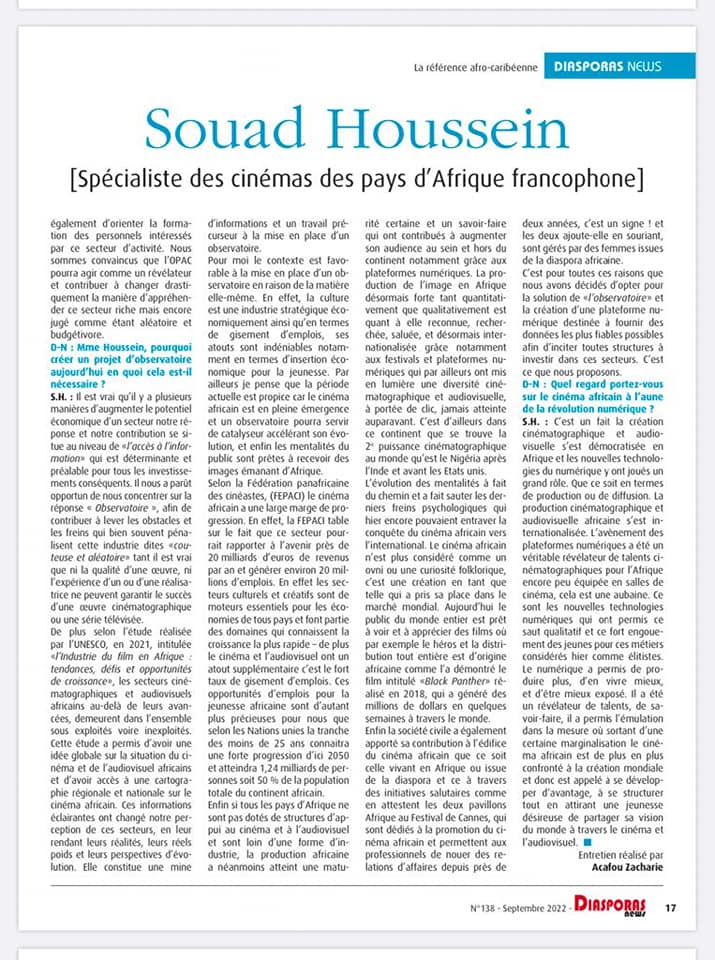
During her long, nearly 25-year career with the International Organization of the Francophone (OF), Madame Souad Houssein, Franco-Djiboutian, specialist in the cinemas of Francophonie African countries, has led and coordinated projects for the development and promotion of cinemas of the countries of the South. Her mission is to manage a funding mechanism for aid in film production (Fonds image de la Francophonie), to support the development of the capacities of professionals and to contribute to improving the visibility of the films that are financed. With a strong track record, she recently embarked upon a vast project: the creation of a pan-African audiovisual and cinema observatory (OPAC).
Diaspora-News: You have built most of your career on the development of cinema, specifically of African countries. Where does your passion for cinema come from and your desire to work towards its development ?
I am one of those people who find their passion and their cause through their profession. Over the years, I discovered that passion took on the colors of activism. I think that this commitment comes from the context of financial austerity in which African cinema found itself at the time, in the 2000s, and which lasted for many years. It is in this context, uncertain and arduous for professionals, constrained in their artistic activity, that shaped this desire to contribute to the development of this sector. An area which is highly important and strategic for a continent which has long been condemned to live through the culture of another. Moreover, I knew that it would be possible to continue my journey because we can all work at our own level for the development of African cinema. To the extent that the development of the cinematographic industry is the fruit of the combined efforts of the precepts of those concerned: the States, the private institutions, organizations, foundations, donors, civil society. For my part, I have always wanted to be engaged in one way or another towards the empowerment and professionalization of African cinema.
D-N: How did the Pan-African Observatory Project for audiovisual and cinema (OPAC) come into being? Could you highlight the main points?
S.H.: It has been nearly five years since the idea of creating a Pan-African Audiovisual and Cinema Observatory germinated in my mind, an observatory which, like the European Audiovisual Observatory (https://www.obs.coe.int/fr/web/observatoire/home), could provide a better understanding of the realities, potentialities and trends of the African moving-image markets continent-wide. However, the Covid-19 pandemic has delayed the schedule for this project, as with many other projects. Finally, it was not until 2022 that I decided to engage in this adventure in cooperation with my partners: Ms. Marie-Paule Babli, lawyer, Mr. Jean Cressant, audiovisual and cinema specialist, and Mr. Servais Locko, multidisciplinary manager.
To describe the project, I would say that the Pan-African Audiovisual and Cinema Observatory (OPAC) is a tool for sustainable cultural development whose mission will be to collect, select, process, analyze and restore relevant data on the cinema and audiovisual markets of the 55 African countries. The OPAC, through its digital platform, will provide information and data, available for online consultation (free or paid). The Observatory aims to serve in particular as a tool to facilitate decision-making in order to provide a better understanding, especially, of the evolution, trends, production, distribution and broadcasting activities of the cinematographic and audiovisual industries in African countries. In the long run, its purpose is to contribute to the economic growth of the African audiovisual sector by attracting private and public capital and encouraging States to put in place policies favorable to the development of an African moving image industry. The data collected will also make it possible to guide the direction of training of personnel interested in this sector of activity. We are convinced that the OPAC will be able to act as an indicator and contribute to a radical change in the manner in which this sector is appreciated--though having many strengths, it is still considered to be risky and budget-consuming.
D-N: Madame Houssein, why create an observatory project now? Why is it necessary?
S.M.: It is true that there are several ways to increase the economic potential of a sector, our response and our contribution is situated at the level of "access to information" which is a crucial prerequisite for all sustained investments. To us it seemed pertinent to concentrate on the "Observatory" response, in order to contribute to breaking down the barriers and the roadblocks which very often penalize this industry said to be “costly” and uncertain. It is also true that neither the quality of a work, nor the experience of a director can guarantee the success of a cinematographic work or a television series.
Moreover, according to the study by UNESCO in 2021, entitled "The African Film Industry: trends, challenges and opportunities for growth" [https://en.unesco.org/creativity/publications/african-film-industry-trends-challenges], in spite of the progress of the African cinematographic and audiovisual sectors, they remain on the whole under-utilized or even untapped. This study made it possible to have an idea of the overall African cinema and audiovisual situation and to have access to regional and national mappings of African cinema. This edifying information has changed our perception of these sectors, by rendering them their own realities, showing their real significance and their own perspectives of their evolution. It is a rich source of information and a precursory in the implementation of an observatory.
For me, the context for laying the foundations of an observatory is favorable because of the material itself. In fact, culture is a strategic industry economically as well as in terms of job opportunities, its benefits are undeniable, particularly in terms of economic aspirations for young people. Moreover, I think that the current period is opportune because African cinema is in full emergence and an observatory could serve as a catalyst accelerating its evolution, and finally the public mind set is ready to receive images coming from Africa. According to the Pan-African Federation of Filmmakers (FEPACI), African cinema has a wide margin of progress. In fact, FEPACI expects that this sector could bring in nearly 20 million euros in revenue per year in the future and generate around 20 million jobs. Indeed, the cultural and creative sectors are key drivers for the economies of all countries and are among the areas experiencing the fastest growth. Furthermore, the cinema and audiovisual sectors have an additional advantage, which is its high job-creating potential. These employment opportunities for African youth are all the more invaluable for us since, according to the United Nations, the under-25 age group will experience strong growth by 2050 and will reach 1.24 billion people, 50% of the total population of the African continent. Finally, even if all African countries do not have support structures for the cinema and audiovisual sector and are far from actually being some kind of industry, African production has nonetheless attained a certain maturity and know-how which have contributed to an increase in audience within and outside the continent, primarily, due to digital platforms.
Moving-image production in Africa, which is now strong both quantitatively and qualitatively, is gaining recognition, being sought after, welcomed, and is now internationalized, due in particular to festivals and digital platforms. As a further matter, within the reach of a click, it has brought to the forefront a cinematographic and audiovisual diversity never achieved before. It is also on this continent that the 2nd cinematic power in the world, Nigeria, after India and before the United States, is found. The evolution of attitudes has come a long way, breaking down the last psychological barriers which still yesterday could hinder African cinema’s push towards the international landscape. African cinema is no longer considered a UFO or a folkloric curiosity, it is a creation on its own merits that has taken its place in the world market. Today audiences around the world are ready to see and enjoy films where, for example, the hero and the entire cast are of African origin, as was demonstrated by the film entitled 'Black Panther' made in 2018, which generated millions of dollars globally in a few weeks. Finally, civil society has also made worthwhile contributions to the building of African cinema, both those from Africa or from the diaspora. For instance, the two African pavilions at the Cannes Film Festival, which for the past two years have been dedicated to the promotion of African cinema, allowing professionals to establish business relationships, it's a sign! And both, [she adds with a smile], are run by women from the African diaspora. It is for all these reasons that we have decided to opt for the "observatory" solution and the creation of a digital platform whose purpose is to provide the most reliable data possible in order to encourage all structures to invest in these sectors. This is what we are proposing.
D-N: What is your perception of African cinema in light of the digital revolution?
S.H.: It is a fact that cinematographic and audio-visual creation in Africa has become democratized and new digital technologies have played a major role in it, both in terms of production or distribution. Similarly, African film and audiovisual production has become internationalized. The advent of digital platforms has been a real developer of cinematographic talent for Africa, which is still poorly equipped with cinemas houses. It has been a godsend. It is the new digital technologies that have allowed this qualitative leap and this intense enthusiasm by young people for these métiers considered yesterday as elitist. The digital has made it possible to produce more, to have better experiences, and to be more visible. It has been a means to develop talent, proficiency, to stimulate competition. To the extent that, having emerged from a certain marginalization, African cinema is increasingly exposed to creative experiences on a global scale; and therefore is called upon to develop more, to structure itself while at the same time attracting young people who have a desire to share its vision of the world through cinema and the audiovisual.