The purpose of the African Women in Cinema Blog is to provide a space to discuss diverse topics relating to African women in cinema--filmmakers, actors, producers, and all film professionals. The blog is a public forum of the Centre for the Study and Research of African Women in Cinema.

Le Blog sur les femmes africaines dans le cinéma est un espace pour l'échange d'informations concernant les réalisatrices, comédiennes, productrices, critiques et toutes professionnelles dans ce domaine. Ceci sert de forum public du Centre pour l'étude et la recherche des femmes africaines dans le cinémas.

ABOUT THE BLOGGER

My photo
Director/Directrice, Centre for the Study and Research of African Women in Cinema | Centre pour l'étude et la recherche des femmes africaines dans le cinéma

Translate

Search This Blog

Showing posts with label Monique Mbeka Phoba. Show all posts

11 October 2025

11 October | Octobre : International Day of the Girl Child | Journée internationale de la fille : A Focus on Related Films by African Women


The day aims to highlight and address the needs and challenges girls face, while promoting girls' empowerment and the fulfillment of their human rights.

Cette Journée vise à mettre en lumière les besoins des filles et à répondre aux défis auxquels elles font face. Cette Journée promeut également l'autonomisation des filles et l'exercice de leurs droits fondamentaux.

The girl-child as main protagonist in a selection of recent films by African women  

La petite fille comme protagoniste principale dans une sélection de films récents par les réalisatrices africaines

Source: African Women in Cinema Blog 

[English]

The filmmakers' message of tolerance and universal humanism comes through the children…child characters are represented as the hope for the desirable gender relations. (Sr. Dr. Dominica Dipio)

In the selection of films that follow, the girl-child plays the main protagonist. This representation of the girl character is an empowering practice as she deals with complex issues regarding her family and the world around her: Five-year-old Nadia lives in the slums of Casablanca where she is surrounded by a wall that separates her from the rest of the city; Elikia, is a five-year old with albinism, which is considered a stereotype by her neighbors; nine-year-old Zeinab opposes moving to Canada because she hates the snow; ten-year-old Mouna who copes with the death of her mother, almost never separates from her doll Ashia; ten-year-old Godelive attends a Catholic convent school in the Congo. However, the strict western education collides with her own memories of the traditions of her grandmother; eight-year-old Aida attempts to ease the suffering of her mother after her father brings a second wife into the household; after being accused of being a witch and placed in a "witches camp", 9-year-old Shula longs for freedom. Seven-year-old Aya lives with her Salafist parents, Mariem and Youssef. For fear of being banished by his Salafist community, Youssef is obliged to impose the wearing of Niqab on his wife. One day, Aya commits an act that will disrupt forever the fate of her family. Casablanca of the late 1970s. Eleven-year-old Hiba is fascinated with the cinema at a time in the history of Morocco where this space is still closed to women. Despite her mother’s interdiction, in order to enter the movie house, Hiba is ready to sell the object of her other passion, her books. Eleven-year-old pre-teen Amy discovers in her new elementary school a group of dancers called: “Les Mignonnes”. Fascinated, she begins a sexy dance, the twerk, hoping to join their band and escape a family upheaval.


[Français]

Le message de tolérance et d'humanisme universel des cinéastes passe par les enfants ... les personnages d'enfants sont représentés comme l'espoir des relations de genre souhaitables. (Sr. Dr. Dominica Dipio)

Dans une sélection de films récents ci-dessous, la petite fille joue le rôle principal. Cette représentation cinématographique nous montre une image forte et valorisante de la petite fille, lorsqu’elle confronte des questions complexes concernant sa famille et le monde qui l’entoure : Mouna, 10 ans, qui fait face à la mort de sa mère, ne se sépare presque jamais de sa poupée Aisha ; Elikia, 5 ans, est atteinte d’albinisme que son voisinage considère comme un stéréotype ; Nadia, 5 ans, vit dans les bidonvilles de Casablanca où elle est entourée d'un mur qui la sépare du reste de la ville ; Godelive, 10 ans, vit dans un pensionnat catholique en Congo y recevant une éducation occidentale. Mais le souvenir de sa grand-mère s’interpose ; Zeinab, qui a neuf ans, ne veux pas vivre au Canada parce qu’elle n’aime pas la neige; Aida, 8 ans, tente de soulager la souffrance de sa mère après que le père amène une seconde femme à la maison; Shula, qui a neuf ans, accusée de sorcellerie et mise dans un camp de sorcières, rêve de liberté. Aya, 7 ans, vit avec ses parents salafistes, Mariem et Youssef. Par peur d'être banni par sa communauté salafiste, Youssef est contraint d'imposer le port du Niqab à sa femme. Un jour, Aya commet un acte qui bouleversera à jamais le destin de sa famille. Casablanca, fin des années 70. Hiba, âgée de 11 ans, est fascinée par le cinéma à un moment de l'histoire du Maroc où ce lieu est encore fermé à la gente féminine. Malgré l'interdiction de sa mère, elle est prête à revendre l'objet de son autre passion, ses livres, pour y entrer. Amy, 11 ans, rencontre un groupe de danseuses appelé : « Les Mignonnes ». Fascinée, elle s’initie à une danse sensuelle, dans l’espoir d’intégrer leur bande et de fuir un bouleversement familial.


13 August 2025

Go Fund Me: Nos Errances, un film de Sorana Munsya et Monique Mbeka Phoba

Go Fund Me: Nos Errances
un film de
Sorana Munsya et Monique Mbeka Phoba
 
Nos Errances retrace les parcours croisés de Clémentine Faïk-Nzuji, première professeure africaine dans une université belge, et Véronique Clette-Gakuba, militante et sociologue. À travers leurs récits, le documentaire explore l’errance de ces deux personnages dans un monde académique marqué par la discrimination.
 
Nos Errances retraces the intersected paths of Clementine Faik-Nzuji, the first African professor at a Belgian university, and activist/sociologist Véronique Clette-Gakuba. Through their stories, the documentary explores the peregrinations of these two figures in an academic world marked by discrimination. 


29 July 2022

African Diasporas. Belgium. The Act of Breathing: Regards afro-féminins - Monique Mbeka Phoba, curator/programmatrice (Brussels/Bruxelles) 23.06-31-07 2022

African Diasporas. Belgium
The Act of Breathing:
 Regards afro-féminins 
Monique Mbeka Phoba, curator/programmatrice
(Brussels/Bruxelles)
23.06-31-07 2022

Source: Cinematek - YouTube

Spotlighting Congolese women cineastes, who are still too little present on this platform, the program will pay tribute on 28 July, with 'Regards afro-féminins': a series of short films where hip-hop, sorority, activism and trauma meet. The session will be followed by a conversation between Monique Mbeka Phoba, Malkia Mutiri and Girl Fact producer Mualuja.

Pour attirer notre attention sur des cinéastes congolaises, encore trop peu présentes dans les traditionnelles sorties salles du mercredi; le 28 juillet, celles-ci sont mises à l’honneur dans le programme ‘Regards afro-féminins’ : une série de courts-métrages où se côtoient hip-hop, sororité, activisme et traumatismes. La séance sera suivie d"une conversation entre Monique Mbeka Phoba, Malkia Mutiri et la productrice de Girl Fact, Mualuja.

Conversation entre Monique Mbeka Phoba et le réalisateur, acteur, poête Nganji Mutiri : "Toni Morrison dit : "Si vous pensez qu'un livre manque, écrivez-le vous-même." J'ai donc pris mes responsabilités. Sans me rendre compte qu'un film belgo-congolais n'avait pas été réalisé depuis longtemps. Je comprends aussi que c'est presque un passage obligé de rester proche de ce que l'on connaît bien au premier film. Mais je n'ai pas envie de remplir la case diversité. Juwaa n'est pas une leçon d'histoire, mais une histoire singulière. Amani et Riziki sont Amani et Riziki, ils ne représentent pas tous les Congolais. Ils ne le peuvent pas non plus. Ce que je crois et pense n'est pas ce que ma sœur croit et pense, bien que nous ayons grandi ensemble. Il existe déjà de grandes différences entre frères et sœurs au sein d'une même famille, alors pourquoi mettre tout un peuple dans le même sac ? Parce qu'il y a un manque de représentation et de diversité dans le cinéma et la télévision, cela se produit encore. Dommage, car dans une salle de cinéma, en compagnie de personnes que vous ne connaissez pas, vous pouvez être profondément ému par des personnages iraniens, coréens, français ou belges dont la religion, la culture, la couleur de peau ou les préférences sexuelles sont complètement différentes. C'est la magie du cinéma.” Nganji Mutiri dans BRUZZ.

The Act of Breathing offers a retrospective of 26 films selected by Monique Mbeka Phoba (23.06-31.07) and the exhibition of 10 in-situ works of art at the Asiat military base in Vilvoorde. At the same time, three other artists will meet in the 'Europa' space of Bozar in Brussels, at the exit of the CINEMATEK movie theatres. Orchestrating the narrative of the project are curators Sorana Munsya and Evelyn Simons. Living Traces, a bridging project between Kinshasa and Brussels, is articulated around various multidisciplinary artistic proposals that will be held between the two capitals between March 2022 and March 2023. The project reflects the desire of KANAL-Centre Pompidou to broaden people's perception by inviting them to discover the artistic diversity of the Congolese, Belgian and Belgian-Congolese communities.

Interview avec/with Monique Mbeka Phoba


 The Act of Breathing: Regards afro-féminins


  Généalogie d’un cinémabelgo-congolais 14.07.2022


11 October 2018

11 October | Octobre 2018 : International Day of the Girl Child | Journée internationale de la fille

11 October | Octobre 2018
International Day of the Girl Child
Journée internationale de la fille


The day aims to highlight and address the needs and challenges girls face, while promoting girls' empowerment and the fulfillment of their human rights.

Cette Journée vise à mettre en lumière les besoins des filles et à répondre aux défis auxquels elles font face. Cette Journée promeut également l'autonomisation des filles et l'exercice de leurs droits fondamentaux.


The girl-child as main protagonist in a selection of recent films by African women  

La petite fille comme protagoniste principale dans une sélection de films récents par les réalisatrices africaines


[English]
In the selection of films that follow, the girl-child plays the main protagonist. This representation of the girl character is an empowering practice as she deals with complex issues regarding her family and the world around her: Five-year-old Nadia lives in the slums of Casablanca where she is surrounded by a wall that separates her from the rest of the city; Elikia, is a five-year old with albinism, which is considered a stereotype by her neighbors; nine-year-old Zeinab opposes moving to Canada because she hates the snow; ten-year-old Mouna who copes with the death of her mother, almost never separates from her doll Ashia; ten-year-old Godelive attends a Catholic convent school in the Congo. However, the strict western education collides with her own memories of the traditions of her grandmother; eight-year-old Aida attempts to ease the suffering of her mother after her father brings a second wife into the household; after being accused of being a witch and placed in a "witches camp", 9-year-old Shula longs for freedom. Seven-year-old Aya lives with her Salafist parents, Mariem and Youssef. For fear of being banished by his Salafist community, Youssef is obliged to impose the wearing of Niqab on his wife. One day, Aya commits an act that will disrupt forever the fate of her family. Casablanca of the late 1970s. Eleven-year-old Hiba is fascinated with the cinema at a time in the history of Morocco where this space is still closed to women. Despite her mother’s interdiction, in order to enter the movie house, Hiba is ready to sell the object of her other passion, her books.

[Français]
Dans une sélection de films récents ci-dessous, la petite fille joue le rôle principal. Cette représentation cinématographique nous montre une image forte et valorisante de la petite fille, lorsqu’elle confronte des questions complexes concernant sa famille et le monde qui l’entoure : Mouna, 10 ans, qui fait face à la mort de sa mère, ne se sépare presque jamais de sa poupée Aisha ; Elikia, 5 ans, est atteinte d’albinisme que son voisinage considère comme un stéréotype ; Nadia, 5 ans, vit dans les bidonvilles de Casablanca où elle est entourée d'un mur qui la sépare du reste de la ville ; Godelive, 10 ans, vit dans un pensionnat catholique en Congo y recevant une éducation occidentale. Mais le souvenir de sa grand-mère s’interpose ; Zeinab, qui a neuf ans, ne veux pas vivre au Canada parce qu’elle n’aime pas la neige; Aida, 8 ans, tente de soulager la souffrance de sa mère après que le père amène une seconde femme à la maison; Shula, qui a neuf ans, accusée de sorcellerie et mise dans un camp de sorcières, rêve de liberté. Aya, 7 ans, vit avec ses parents salafistes, Mariem et Youssef. Par peur d'être banni par sa communauté salafiste, Youssef est contraint d'imposer le port du Niqab à sa femme. Un jour, Aya commet un acte qui bouleversera à jamais le destin de sa famille. Casablanca, fin des années 70. Hiba, âgée de 11 ans, est fascinée par le cinéma à un moment de l'histoire du Maroc où ce lieu est encore fermé à la gente féminine. Malgré l'interdiction de sa mère, elle est prête à revendre l'objet de son autre passion, ses livres, pour y entrer.


23 March 2018

African Women in Cinema Blog Updates | Actualités - 23.03.2018 News around the Internet | Les infos autour de l’Internet


African Women in Cinema Blog
Updates | Actualités
23-03-2018

News around the Internet |
Les infos autour de l’Internet

Content | Contenu

African Women Filmmakers
Josza Anjembe
Angela Aquereburu
Amma Asante
Awotele
Claire Diao
Festival Africain des Films de Femmes Cinéastes (FAFFCI)
Huguette Goudjo
Tiffany Haddish
Nadjibatou Ibrahim
Philippa Ndisi-Herrmann
Priscilla Nwanah
Monique Mbeka Phoba
Apolline Traoré


African Women Filmmakers
African women filmmakers breakdown barriers and challenge taboos. 08 March 2018. Emmanuelle Landais. dw.com - http://www.dw.com/en/african-women-filmmakers-break-down-barriers-and-challenge-taboos/a-42886479

Josza Anjembe
J’ai decouvert la fiction comme si je decouvrais une planete. Par Falila Gbadamassi | Publié le 02/03/2018. Geopolis - http://geopolis.francetvinfo.fr/josza-anjembe-j-ai-decouvert-la-fiction-comme-si-je-decouvrais-une-planete-180925

Angela Aquereburu
Angela Aquereburu, la Shonda Rhimes togolaise. Intothechic. Leslie Muya. 19 février 2018. intothechic - http://www.intothechic.com/32438/culture/angela-aquereburu-la-reine-des-series-togolaises-la-femme-a-sa-place/

Amma Asante
Amma Asante To Direct Drama Thriller ‘The Billion Dollar Spy’. 15 March 2018. Hollywoodsblackrenaissance - http://hollywoodsblackrenaissance.com/amma-asante-direct-drama-thriller-billion-dollar-spy/

Awotele No. 9 - Mars/March 2018
Focus: Succès Feminins en Afrique | Women Triumphing in Africa
- Marie-Laurentine Bayala: Produire au Sud - Des femmes apportent de nouvelles perspectives au Burkina Faso | Producing in the South: Women Bring New Perspectives to Burkina Faso
- Martial Nguea: Re(belles) Pionnières | Pioneering Rebels
- Fatou Kiné Sene: Succès Feminins dansle 7e art | Female Success in the 7th Art
Close-up
Michel Amarger: Entretien/interview avec/with Rahmatou Keita
Focus: Ciné et TV: Quel espace pour les femmes? | Film & TV: What Role for Women?
- Bitania Tadesse: Les Femmes dans le cinéma et à la télévision éthiopienne | FemaleForces in Ethiopian TV and Film
- Aderinsola Ajao: Nigeria: Les femmes impactent le cinéma et la télévision | Women impacting Nigerian Film and TV
- Domoina Ratsara: Quand femme et cinéma font bon ménage | When women and cinema make a good pair
Flashback: Journées Cinématographiques de Carthage
Claire Diao: The Train of Salt and Sugar

Claire Diao
JCFA 2018 : qui est Claire Diao?. Assétou Maiga. 03-05-2018. Queenmafa - https://queenmafa.net/2018/03/05/jcfa-2018-claire-diao/

Festival Africain des Films de Femmes Cinéastes (FAFFCI) 
La première edition du FAFFCI a porté ses fruits. 21 mars 2018. L’œil d’afrique - http://loeildafrique.over-blog.com/2018/03/genre-et-cinema-une-approche-inclusive.html

Huguette Goudjo
Costumière de cinéma et fière d’être. 14-03-2018. EcranBenin - https://ecranbenin.net/2018/03/14/huguette-goudjo-costumiere-de-cinema-et-fiere/

Tiffany Haddish
Tiffany Haddish Talks About Upcoming TBS Comedy ‘The Last OG,’ the Oscars, & the Importance of Authenticity. K. Nicole Mills. 13 March 2018. Hollywoodsblackrenaissance - http://hollywoodsblackrenaissance.com/tiffany-haddish-sxsw-the-last-og/
Nadjibatou Ibrahim
Tout sur l’actrice béninoise Nadjibatou Ibrahim. 07 mars 2018. EcranBenin - https://ecranbenin.net/2018/03/07/tout-sur-lactrice-beninoise-nadjibatou-ibrahim/

Priscilla Nwanah
Producer extraordinare. Wocaf-instagram - https://www.instagram.com/p/Be4Mxn_lAOe/

Monique Mbeka Phoba
Master class à Isma. 08 mars 2018. Isma-benin.org - http://isma-benin.org/2016/?p=3809

Apolline Traoré
Burkina Faso director gives African women authentic voice
Joe Bavier. 05 March 2018. Reuters - https://www.reuters.com/article/us-burkina-filmfestival-director/burkina-faso-director-gives-african-women-authentic-voice-idUSKBN16C0WP

VIDEO:

Philippa Ndisi-Herrmann
https://vimeo.com/177446004
Trailer for Feature-length Documentary, New Moon, by Philippa Ndisi-Herrmann (2018).


10 March 2017

The girl-child as main protagonist in a selection of recent films by African women | La petite fille comme protagoniste principale dans une sélection de films récents par les réalisatrices africaines


The girl-child as main protagonist in a selection of recent films by African women  

La petite fille comme protagoniste principale dans une sélection de films récents par les réalisatrices africaines

[English]

The filmmakers' message of tolerance and universal humanism comes through the children…child characters are represented as the hope for the desirable gender relations. (Sr. Dr. Dominica Dipio)

In the selection of films that follow, the girl-child plays the main protagonist. This representation of the girl character is an empowering practice as she deals with complex issues regarding her family and the world around her: Five-year-old Nadia lives in the slums of Casablanca where she is surrounded by a wall that separates her from the rest of the city; Elikia, is a five-year old with albinism, which is considered a stereotype by her neighbors; nine-year-old Zeinab opposes moving to Canada because she hates the snow; ten-year-old Mouna who copes with the death of her mother, almost never separates from her doll Ashia; ten-year-old Godelive attends a Catholic convent school in the Congo. However, the strict western education collides with her own memories of the traditions of her grandmother; eight-year-old Aida attempts to ease the suffering of her mother after her father brings a second wife into the household; after being accused of being a witch and placed in a "witches camp", 9-year-old Shula longs for freedom. Seven-year-old Aya lives with her Salafist parents, Mariem and Youssef. For fear of being banished by his Salafist community, Youssef is obliged to impose the wearing of Niqab on his wife. One day, Aya commits an act that will disrupt forever the fate of her family. Casablanca of the late 1970s. Eleven-year-old Hiba is fascinated with the cinema at a time in the history of Morocco where this space is still closed to women. Despite her mother’s interdiction, in order to enter the movie house, Hiba is ready to sell the object of her other passion, her books. Eleven-year-old pre-teen Amy discovers in her new elementary school a group of dancers called: “Les Mignonnes”. Fascinated, she begins a sexy dance, the twerk, hoping to join their band and escape a family upheaval.


[Français]

Le message de tolérance et d'humanisme universel des cinéastes passe par les enfants ... les personnages d'enfants sont représentés comme l'espoir des relations de genre souhaitables. (Sr. Dr. Dominica Dipio)

Dans une sélection de films récents ci-dessous, la petite fille joue le rôle principal. Cette représentation cinématographique nous montre une image forte et valorisante de la petite fille, lorsqu’elle confronte des questions complexes concernant sa famille et le monde qui l’entoure : Mouna, 10 ans, qui fait face à la mort de sa mère, ne se sépare presque jamais de sa poupée Aisha ; Elikia, 5 ans, est atteinte d’albinisme que son voisinage considère comme un stéréotype ; Nadia, 5 ans, vit dans les bidonvilles de Casablanca où elle est entourée d'un mur qui la sépare du reste de la ville ; Godelive, 10 ans, vit dans un pensionnat catholique en Congo y recevant une éducation occidentale. Mais le souvenir de sa grand-mère s’interpose ; Zeinab, qui a neuf ans, ne veux pas vivre au Canada parce qu’elle n’aime pas la neige; Aida, 8 ans, tente de soulager la souffrance de sa mère après que le père amène une seconde femme à la maison; Shula, qui a neuf ans, accusée de sorcellerie et mise dans un camp de sorcières, rêve de liberté. Aya, 7 ans, vit avec ses parents salafistes, Mariem et Youssef. Par peur d'être banni par sa communauté salafiste, Youssef est contraint d'imposer le port du Niqab à sa femme. Un jour, Aya commet un acte qui bouleversera à jamais le destin de sa famille. Casablanca, fin des années 70. Hiba, âgée de 11 ans, est fascinée par le cinéma à un moment de l'histoire du Maroc où ce lieu est encore fermé à la gente féminine. Malgré l'interdiction de sa mère, elle est prête à revendre l'objet de son autre passion, ses livres, pour y entrer. Amy, 11 ans, rencontre un groupe de danseuses appelé : « Les Mignonnes ». Fascinée, elle s’initie à une danse sensuelle, dans l’espoir d’intégrer leur bande et de fuir un bouleversement familial.


Also see : UN International Day of the Girl Child | Journée internationale de la fille

24 January 2016

2016 Festival Elle tournent | Dames Draaien (Women shoot films) – Monique Mbeka Phoba : Masterclass – Belgium | Belgique


2016 Festival Elle tournent | Dames Draaien (Women shoot films) – Monique Mbeka Phoba : Masterclass – Belgium | Belgique - 28 January - 1 February | 28 janvier - 01 février

Source : Festival Elle Tournent - http://ellestournent.be 

[ENGLISH] FRANÇAIS CI-APRÈS

The Elles Tournent (women shoot films) Festival is back, new locations, new date: the 8th edition arrives in January, one month between the future and the past, a whole programme!

A festival of women filmmakers sharing discoveries and passions with a cohort of film enthusiasts and filmmakers.

Again this year there is a range of selections: fiction, documentary, animation, short and filmed performances, unreleased, rare films or coming out of oblivion. The more than 40 filmmakers from Belgium and around the world amaze us with the originality, relevance, innovative vision of their films and their power of expression, their commitment, their poetry and humour.

The Festival is a concert of voices of the world. A Korean shows us grandmothers who learn Kung Fu in Kenya; a Lebanese-Canadian takes us in a speed car race of Palestinian women; a Londoner shows how a former prostitute fights against sexual violence in Chicago; deaf women express themselves and are heard by a Canadian; Iranian women filmmakers dream of the future of their countries; a Congolese filmmaker examines the theme of colonisation, and many others.

The festival is full of events and meetings. Film professionals pose important questions, academics analyse gender, and researchers examine figures and data. This is an opportunity to formulate strategies in order to assert the significance of a women’s cultural critique.

"To look at the world through women's eyes is to expand its 180 degree field of vision.
Monique Mbeka Phoba : Masterclass - Colonization in present-day Belgian cinema: still a taboo subject?

“Faced with the taboo of colonial imagery and hearing that I was the only one to have made a fiction on this period, I decided to go and explore this secret territory: current Belgian films about colonialism. And hallelujah, the majority of directors who have chosen this theme are women. Strange, isn’t it?” Monique Mbeka Phoba

FRANÇAIS

Le Festival Elles Tournent est de retour, nouveaux lieux, nouvelle date: la 8ème édition arrive en janvier, un mois entre avenir et passé, tout un programme ! 

Un festival de réalisatrices, pour partager les découvertes et les enthousiasmes d’une équipe de cinéphiles et de cinéastes. 

Cette année encore l’offre est de choix. Avec des fictions, documentaires, animations, courts métrages et performances filmées, inédits, films rares ou sorts de l’oubli, plus de 40 réalisatrices de Belgique et du monde entier nous surprennent par l’originalité, la pertinence, la vision novatrice de leurs films ainsi que leur puissance d'expression, leur engagement, leur poésie et leur humour.

Le Festival est un concert de voix du monde. Une Coréenne nous fait découvrir des grand-mères qui apprennent le Kung Fu au Kenya, une Libano-canadienne nous entraine dans la course des bolides de femmes palestiniennes, une Londonienne montre comment une ex-prostituée lutte contre la violence sexuelle à Chicago, les femmes sourdes s’expriment et sont entendues par une Canadienne, des réalisatrices d’Iran rêvent l’avenir de leur pays, une réalisatrice congolaise interroge le thème de la colonisation et bien d’autres encore.

Le Festival foisonne d’évènements et de rencontres. Les professionnelles du cinéma posent des bonnes questions, les universitaires analysent le genre, les chercheuses examinent les chiffres et les données. C’est l’occasion de préparer des stratégies pour affirmer la nécessité d'une pensée culturelle des femmes.

"Regarder le monde par les yeux des femmes, c’est élargir son champ de vision de 180 degrés. 

Monique Mbeka Phoba : Masterclass - La colonisation dans le cinéma belge actuel: un sujet tabou?

“En entreprenant mon court-métrage 'Soeur Oyo', je me suis confrontée au tabou de l'imagerie coloniale. A force d'entendre que j'étais la seule à avoir fait une fiction sur cette période, cela a éveillé mon intérêt. J'ai donc décidé d'aller explorer ce territoire encore secret: les films belges actuels sur la thématique coloniale. Et alléluia, la majorité des réalisateurs qui ont choisi ce thème sont des femmes. Mystère, vous avez dit mystère?” – Monique Mbeka Phoba


17 April 2015

That Sister There! by Michèle Solle, a review of the film "Sister Oyo" by Monique Mbeka Phoba | Cette soeur-là ! par Michèle Solle, une critique du film “Soeur Oyo” de Monique Mbeka Phoba

That Sister There! by Michèle Solle, a review of the film “Sister Oyo” by Monique Mbeka Phoba

Cette soeur-là ! par Michèle Solle une critique du film “Soeur Oyo” de Monique Mbeka Phoba: http://clapnoir.org/spip.php?article1095

Source: clapnoir.org VERSION ORIGINALE EN FRANCAIS. Translated below from French by Beti Ellerson.


Belgian Congo, the 1950s: welcome to the world of Godelive, a seven-year-old girl sent far away from her family to receive a Catholic education by the Belgian sisters of the Congregation of the Sacred Heart, the only school in the country promoting the French language! A close-up of a pair of frightened eyes on a round face and a pair of scissors that overpowers the wild mane of hair: it is to subdue the rebellious nature.

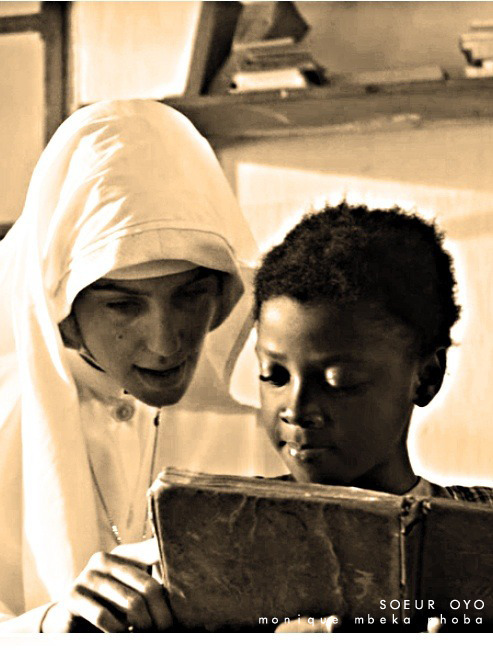
First reading lesson: a very young nun dressed in white, Bible in hand, with a very thick Flemish accent, has the students read; Godelive is paralysed with shame, crushed under the mockery of the older Albertine, the ringleader who, responsible for helping her during recess, will make of her the official scapegoat.

In black and white, light and shadow: the little girl stumbles about like a blind person in this cruel world, hurt during each discovery, clinging to the enlighten nun, Sister Oyo (Sister Oyo in Lingala, which translates as, “that sister there”) who wears a white cornette and habit, her reputation and intentions irreproachable—but both in fact are at risk.

In colour: equatorial lushness, a chromatic explosion of dreams, in contrast to the tamed garden of colonial civilisation, and yet a snake prowls at the borders.

At the head of this experimental boarding school, whose purpose is to train the girls and future brides of the "evolved"—so named by the colonial regime—reigns the mother superior, who, in these exquisite surroundings, tyrannizes Astrid, the so blonde, so young, so idealistic nun and teacher of the religious order of the Congregation of the Sacred Heart.

When there are no rules of the game, the actions and behaviour of adults appear to be of even greater magnitude. Godelive opposes a surface passivity to the injustice that she feels, she flees; in her dreams she reunites with her grandmother, where she glimpses into a life peopled by guardian spirits.

At the same time she closely follows the white nun, discovering her secrets. One day at the announcement of the bishop’s arrival there is uproar in this little world. The girls learn a hymn, a gardener in charge of the flowers comes out of the shadows ... Everything is unhinged, the snake enters into the garden, the veneer cracks, life scores a few points, truths and fantasies crossfade, an unimaginable rapprochement of impulses. Victim of the utmost cruelty, Godelive does not sing the Canticorum Jubilo, but she has rediscovered the path of her people, that of the life more powerful than rules, that of freedom…

Monique Mbeka Phoba, Belgian filmmaker of Congolese origin, has devoted her career to making documentaries. For her first fiction, she adapts her own story that recounts her mother’s time at the Mboma Mbanza boarding school near Leopoldville.

What sparked this idea? Fred Zinneman’s film, The Nun's Story (1959), with Audrey Hepburn as a religious, struggling with her doubts while in a Congolese hospital... How could one deny the kinship between the Hollywood actress’s beauty and that of Sister Oyo’s Laura Verlinden?

The superb image captures the ambivalence of this universe, the young actresses are brilliantly directed, and the mastery of the narrative ellipsis immediately places this short 23 minute 45 second film in the big leagues.

One may have preferred allusion to explanation of the idea; there are situations that may be developed, characters to be accompanied, angles to explore... Thus, Monique Mbeka Phoba, having honed her brushes with this first fiction, is now preparing the long version. See you then!

Michèle Solle
Photo credit: Monique Mbeka Phoba 

Link | Lien


14 February 2015

FESPACO 2015 – Monique Mbeka Phoba: “Sœur Oyo” | “Sister Oyo”

Monique Mbeka Phoba: during the shooting | pendant le tournage
Fespaco 2015 – Short film in competition | court métrage en compétition

Sœur Oyo | “Sister Oyo” (2014)
Monique Mbeka Phoba (DCR-Belgium/Belgique)

The filmmaker | La réalisatrice

[English]
Monique Mbeka Phoba was born in 1962 in Brussels; daughter of a diplomat, she spent school holidays in the Congo. At the age of sixteen, after her father’s departure from his post she moved to Belgium. She studied at the Free University of Brussels where she was actively involved in the programmes of Radio Campus, producing many shows. After a degree in Commercial and International Sciences at the Institut d'Etudes Supérieures de Saint-Luc in Brussels, she enrolled in an introductory course in video documentary at Ateliers Varan, created by Jean Rouch, in Paris. In 1991 she directed Revue en vrac with Fred Mongu, journalist of the national television of Zaire. The film gives a perspective on the birth of the independent and pluralist press in the Congo. She continued with several documentaries all of which made a connection with Africa (she lived in Benin for several years and worked for the Benin TV) Rentrer? (1993); Deux petits tours et puis s'en vont (1997 - on the presidential elections in Benin); Un rêve d'indépendance (1998); Sorcière, la vie (2004); Entre la coupe et l’élection (2007).

[Français]
Monique Mbeka Phoba est née en 1962 à Bruxelles. Fille de diplomate, elle ne va au Congo qu'à l'occasion des vacances scolaires. Elle s'installe en Belgique à seize ans quand son père renonce à ses fonctions. Elle étudie à l'Université libre de Bruxelles où elle participe activement aux émissions de Radio Campus et elle réalise de nombreux reportages. Après une licence en sciences commerciales et internationales à l'Institut d'Etudes Supérieures de Saint-Luc à Bruxelles, elle fait un stage d'initiation à la vidéo documentaire aux Ateliers Varan à Paris, créés par Jean Rouch. En 1991, elle réalise avec Fred Mongu, journaliste de la Télévision nationale zaïroise, Revue en vrac (regard sur la naissance de la presse indépendante et pluraliste au Congo. Suivront plusieurs documentaires qui ont toujours un lien avec l'Afrique (elle a vécu au Bénin plusieurs années et a travaillé pour la télévision béninoise) : Rentrer ? (1993) ; Deux petits tours et puis s'en vont (1997 - sur les élections présidentielles au Bénin) ; Un rêve d'indépendance (1998) ; Sorcière, la vie (2004) ; Entre la coupe et l’élection (2007). (Africultures)

Synopsis

[English]
Set in the Belgian Congo in the 1950s, Sister Oyo tells the story of Godelive, a Congolese schoolgirl at the Catholic boarding school Mbanza-Mboma, the premiere French language school for Congolese girls. She is to be westernized, following the will of her parents, but the memory of her grandmother intervenes

[Français]
Dans le Congo colonial des années 50, une écolière congolaise, Godelive, vit dans le pensionnat catholique de Mbanza-Mboma, première école en français pour congolaises. Elle s'occidentalise, suivant le souhait de ses parents mais le souvenir de sa grand-mère s’interpose…

[English]
Monique Mbeka Phoba, scriptwriter, director and producer of the Sister Oyo talks about the film and her passionate experiences during the film production in an excerpt of an interview for the Africa Women in Cinema Blog. 

The title of the film, "Sister Oyo," which means in Lingala, in a slightly pejorative manner: "That sister there." So there is a kind of subtext, which would be: "This sister there, is she really what she appears to be?".

I probably got the idea for the film "Sister Oyo," the first time I realized that my mother could have been one of those little black girls seen in the famous film, The Nun’s Story (1959) by Fred Zinnemann, starring Audrey Hepburn. In fact, she lived for some time at a boarding school, in contact with Belgian nuns... And, furthermore Audrey Hepburn also played the role of a Belgian nun.

During the colonial period, the boarding school of the Sacred Heart of Mbanza-Mboma, in the province of Bas-Congo, created in 1947, had long been the only institution where Congolese schoolgirls could take their studies in French and not in a Congolese language. Unlike other African colonies under the British or French administration, where learning the language of the settlers was a sine qua non of education, the majority of Congolese children studied in their original language. Therefore, to receive instruction in French and learn to speak it fluently was considered a must. As the only institution of its kind, the boarding school of Mbanza-Mboma therefore received schoolgirls from across the country, and to be able to have their offspring admitted there was evidence of the social mobility coveted by the évolués. 

But who were these évolués? This category of Congolese made a lot of hullabaloo at the end of the Second World War, telling the Belgian colonial authorities who then ruled the country, that they would lose a lot for not treating them differently from the masses of other Congolese who were considered "uncivilized", to use the demeaning language that was current at the time...

In spite of this, my mother, a child and woman among the évolués, has hardly spoken to me about it. She attended the boarding school of Mbanza-Mboma a few years before her marriage and told me anecdotes, like the story of the snake that got into their dormitory... And so I said to myself as I was watching these “exotic” Hollywood films, without thinking much beyond that pleasure of enjoying a good story: "This is my mother, by the way, who is being filmed in this manner..." And hence this change of perspective was stunning for me!

I began to question these inter-perspectives: mine regarding this schoolgirl that was my mother, this colonial era during which she lived and which continues to be present within her and the Congo, these imposing white nuns, with their amazing headdress, the perspectives of the Belgian nuns toward their students, but also on the male and Congolese bodies which surrounded them.

God, the Devil, the Virgin Mary, angels, the colonial order and the hymns in the background, all in the heart of darkness of a rainforest...I thought there was something on the order of a Devil's cauldron in the process of boiling, reducing to smoke the pretense and false appearances. And that from there, all the essentials could then appear: these human beings, without the stamp of their label, who were they, who are they now? So if on one beautiful day God and the Devil came face to face in the forest, taking hostage the body of a nun who discovers she is also a woman, in this microcosm imbued in incommunicability and racial hierarchy, what would be called into question?

In short, seeking the unofficial history and corpses in the closet, weaving together the stories of forbidden couples with anecdotes of my mother, I formed a story that I adapted into a short film.

[Français]
Monique Mbeka Phoba, scénariste, réalisatrice et productrice du film « Sœur oyo » nous parle de ses expériences passionantes autour de la realisation (extrait d’entretien pour l’African Women in Cinema Blog)

Le titre du film est : « Sœur oyo », ce qui veut dire en lingala, de façon légèrement péjorative : « cette sœur-là ». Il y a donc une sorte de sous-texte, qui serait : « Cette sœur-là, est-elle bien celle qu’elle paraît être ? ». 

J'ai sans doute eu l’idée de ce film : « Sœur oyo », la première fois que je me suis rendue compte que ma mère aurait pu être une de ces « négrillonnes » vues dans le film "Au risque de se perdre" (1959), le fameux film de Fred Zinnemann, avec Audrey Hepburn. Elle a vécu en effet un certain temps dans un pensionnat, au contact des religieuses belges… Et Audrey Hepburn jouait d’ailleurs le rôle d’une religieuse belge.

A l’époque coloniale, le pensionnat du Sacré-Cœur de Mbanza-Mboma, dans la province du Bas-Congo, créé en 1947, a été longtemps la seule institution où des écolières congolaises pouvaient suivre leurs cours en français et non dans une langue congolaise. Contrairement aux autres colonies africaines, sous administration anglaise ou française, où l’apprentissage de la langue des colons était un sine qua non de la formation, la plupart du temps, les enfants congolais suivaient les cours dans leur langue originelle. De ce fait, bénéficier d’un enseignement en français et savoir le parler couramment était considéré comme un must. Etant la seule institution de ce type, le pensionnat de Mbanza-Mboma recevait donc des écolières de tout le pays et pouvoir y faire admettre sa progéniture était une des preuves d’ascension sociale dont raffolaient les évolués…

Mais, qui étaient les évolués ? Cette catégorie de congolais fit beaucoup de bruit, au sortir de la deuxième guerre mondiale, pour représenter aux autorités coloniales belges qui dirigeaient alors le pays, qu’elles perdaient beaucoup à ne pas les traiter différemment de la masse des autres congolais encore “non civilisés”, pour employer le langage dévalorisant qui avait cours à l’époque…

De tout cela, ma mère, fille et femme d’évolué, ne m’a guère parlé. Elle a fréquenté le pensionnat de Mbanza-Mboma, quelques années avant son mariage et m’en a raconté des anecdotes, comme l’histoire de ce serpent qui se serait introduit dans leur dortoir… Et, je me suis donc dit, alors que je regardais ces films hollywoodiens et exotiques jusque-là, sans penser guère plus loin qu’au plaisir de savourer une bonne histoire : « Mais, au fait, c'est ma mère qu'on filme ainsi… ». Et dès lors, le changement de perspective a été étourdissant !

J’ai commencé à m’interroger sur ces inter-regards : le mien sur cette écolière qu’était ma mère, sur cette époque coloniale qu’elle avait vécu et qui continue d’être présente en elle et au Congo, sur ces impressionnantes religieuses blanches, aux incroyables cornettes, le regard de ces religieuses belges sur leurs élèves, mais aussi sur les corps masculins et congolais, qui les environnaient…

Avec Dieu, le Diable, la Vierge Marie, les Anges, l’ordre colonial et les cantiques en arrière-plan sonore, tout cela au cœur des ténèbres d’une forêt équatoriale...Je me suis dit qu’il y avait quelque chose de l’ordre d’un chaudron du Diable, en train de bouillonner, réduisant en fumée tous les faux-semblants et les faux paraîtres … Et qu’à partir de là, pouvaient apparaître les fondamentaux : ces êtres humains, sans le poinçon de leur étiquetage, qui étaient-ils, qui sont-ils toujours ? Donc si le Bon Dieu et le Diable se font face un beau jour dans la forêt, prenant en otage le corps d’une religieuse qui découvre qu’elle est aussi une femme, quelle remise en cause peut-il se produire, dans ce microcosme qui macère dans l’incommunicabilité et la hiérarchisation raciale ?

Bref, en quête d’histoire non-officielle et de cadavres dans les placards, en tricotant ensemble ces histoires de couples interdits avec les anecdotes de ma mère, j’ai tiré une nouvelle, que j’ai donc adapté en un court-métrage…

Images: ©Soeur Oyo - Monique Mbeka Phoba

Link | Lien


14 June 2014

African Women Make Soccer Movies


Photo source: CAF African Women Championship 2010
During this time of worldwide excitement around the 2014 World Cup hosted by Brazil, the African Women in Cinema Blog highlights the filmmaking experiences of African women who focus their cameras, from diverse perspectives, on soccer.

Monique Mbeka Phoba who co-directed with Guy Kabeya Muya, Between the Cup and the Election (2008), followed the members of the 1974 Leopards, the first team from sub-Saharan Africa to qualify for the World Cup. Ngardy Conteh with Allan Tong are in the development stages of the film Leone Stars about an amputee soccer team in Sierra Leone, comprised of child survivors of the civil war. Florence Ayisi’s 2005 documentary Zanzibar Soccer Queens follows this team of talented and determine women, especially as it relates to sport and women’s bodies in a majority Muslim population. 


In addition, the Ladies’ Turn association, which works with young Senegalese girls and women to develop leadership and teamwork skills through soccer, was featured in the 2012 film of the same name by Helene Harder.

Between The Cup and The Election
Monique Mbeka Phoba and Guy Kabeya Muya, 2008, 56 min.

Inspired by the 2006 elections in Congo, a group of film students sets out to make a film. They track down members of the 1974 Leopards, Zaire's national soccer squad, the first team from sub-Saharan Africa to qualify for the World Cup. After a dismal first round performance -- the Leopards were outscored 14-0 in three games -- the players returned home in disgrace and drifted into obscurity. The team's captain, however, has fared better and is running for political office in Kinshasa. Deftly weaving past and present, Between the Cup and the Election offers a personal and endearing study of the intersection between sport and politics.


Between The Cup And The Election – Trailer 


Leone Stars
Ngardy Conteh and Allan Tong 

Documentary in development about an amputee soccer team in Sierra Leone, child survivors of the civil war

Feature length documentary (in development) about amputee soccer in Sierra Leone and national team's journey to the World Amputee Football Championships in 2012.

They were outcasts ever since they were boys when rebel soldiers hacked off their arms and legs in Sierra Leone's civil war. With no families, no jobs and no homes, these young men grew up with nothing until they discovered the healing powers of the Beautiful Game.

Soccer gives them something to fight for. Soccer makes them heroes to their countrymen. Soccer turns them from victims to champions. However, victory isn’t about winning the game, but about restoring dignity and hope in the bleakest of situations

Facebook

Leone Stars Documentary Trailer

Zanzibar Soccer Queens
Florence Ayisi has this to say about the film:

Zanzibar Soccer Queens is a documentary that presents fresh insights into other lived experiences and realities in Africa, particularly women’s experiences. The stories of the players of Women Fighters present a complex and diverse perspective of untold African Herstories: visions of hope; self-determination; empowerment; solidarity; aspirations and personal identity. These women cross the boundaries of how a woman should be in their society. They are undertaking extraordinary steps to define and determine their ambitions and fate. I was attracted to their courage and efforts to achieve personal goals beyond the cramped borders of gender lines, traditional and cultural expectations that prescribe of how women should dress or behave

Source: Florence Ayisi's Soccer Queens

Zanzibar Soccer Queens – Impact Study


Ladies’ Turn
Helene Harder, The Director’s Statement:
Using the Ladies’ Turn tournament as a starting point and following the people who invest their talent and their convictions in its success, the film seeks to expose both a Senegalese and international public to the determination of the players despite the difficulties and prejudices that they face. In Senegal as in many other countries, soccer is considered a sport for men, not women.  With the help of the Ladies’ Turn team, Senegalese girls fight to follow their passion for playing soccer all the way from small, neighborhood fields to the tournament finals in Dakar’s newest stadium.  They win a new visibility that may be a reflection of the role that women are increasingly forging in Senegalese society. By following the tournament’s matches and stories, the film plunges the spectator into a human adventure that will bring out the force, the contradictions, and the beauty of a Senegal open to the world and in constant evolution.

Ladies’ Turn Website http://www.ladiesturn.org/LadiesTurn_English/Movie.html 

Film trailer: http://vimeo.com/10548713 

Blog Archive