The purpose of the African Women in Cinema Blog is to provide a space to discuss diverse topics relating to African women in cinema--filmmakers, actors, producers, and all film professionals. The blog is a public forum of the Centre for the Study and Research of African Women in Cinema.

Le Blog sur les femmes africaines dans le cinéma est un espace pour l'échange d'informations concernant les réalisatrices, comédiennes, productrices, critiques et toutes professionnelles dans ce domaine. Ceci sert de forum public du Centre pour l'étude et la recherche des femmes africaines dans le cinémas.

ABOUT THE BLOGGER

My photo
Director/Directrice, Centre for the Study and Research of African Women in Cinema | Centre pour l'étude et la recherche des femmes africaines dans le cinéma

Translate

Search This Blog

Showing posts with label Rosine Mbakam. Show all posts

04 June 2024

Mujeres por África : ELLAS SON CINE 12 - 2024 Madrid (They [women] are cinema) Ramata-Toulaye Sy, Myriam Uwiragiye Birara, Sofia Alaoui, Rosine Mbakam, Kaouther Ben Hania

Mujeres por África
ELLAS SON CINE 12 - 2024 Madrid
(They [women] are cinema)
Ramata-Toulaye Sy, Myriam Uwiragiye Birara, Sofia Alaoui, Rosine Mbakam, Kaouther Ben Hania

Mujeres por África organiza esta muestra de cine para dar visibilidad al audiovisual femenino del continente

Ellas son Cine, la muestra de películas dirigidas por mujeres africanas, regresa un año más a la Sala Berlanga de la Fundación SGAE en Madrid (c/Andrés Mellado 53) en su decimosegunda edición, del 4 al 8 de junio con proyecciones a las 19.30 horas. Y lo hace con cinco películas de directoras que recorren el continente africano de este a oeste, de norte a sur: Banel et Adama, de la senegalesa Ramata-Toulaye Sy; The Bride, de la ruandesa Myriam Uwiragiye Birara; Animalia, de Sofia Alaoui, originaria de Marruecos; Mambar Pierrette, de la camerunense Rosine Mbakam, y, desde Túnez y en cooperación con Arabia Saudí, Les filles d’Olfa, de Kaouther Ben Hania.

***

Mujeres por África [Women for Africa] organizes this film exhibition to give visibility to women audiovisuals on the continent

Ellas son cine (They [women] are cinema) of the Fundación Mujeres por África returns to the Sala Berlanga of the SGAE Foundation in Madrid for its 12th edition from 4-8 June with five films that reflect the social condition of women throughout the continent from east to west, from north to south. Films by women from Senegal, Rwanda, Morocco, Cameroon and Tunisia: Banel et Adama by Senegalese Ramata-Toulaye Sy; The Bride by Rwandan Myriam Uwiragiye Birara; Animalia by Sofia Alaoui from Morocco; Mambar Pierrette by Cameroonian Rosine Mbakam, and from Tunisia in cooperation with Saudia Arabia, Les filles d’Olfa by Kaouther Ben Hania.
 

28 January 2024

Retrospective Rosine Mbakam - Un état du monde - State of the world 2024 - Forum des images

Retrospective Rosine Mbakam - Un état du monde - State of the world 2024 
Forum des images 

www-forumdesimages-fr.
Forum des images, Paris

Excerpts of program description translated from French

“How do I access people’s reality, how do find my place in their lives”

“When one films Africa, everything is shown, even things that have nothing to do with the story”

A homage to women. These portraits filmed by Rosine Mbakam, present their life stories. At the same time difficult, they are embedded in the strength and serenity of daily life. Rosine Mbakam's cinematic gaze explores myriad issues at the intersection of documentary and fiction.

“Coming from documentary filmmaking, I respect what I find. I simply looked at reality, and it gave me back what I wanted,” explains the Belgium-based Cameroonian filmmaker regarding Mambar Pierrette, selected for the 2023 Filmmakers’ Fortnight. After completing her studies at in Cameroon, she continued at INSAS in Brussels, where she made several other portraits (Chez Jolie Coiffure, Les Deux Visages d'une femme bamileké, Les Prières de Delphine).

In partnership with the Wallonia-Brussels Center in Paris.

Les Prières de Delphine by Rosine Mbakam
In the presence of the cineaste.
Sunday, January 28, 8 p.m.

Chez Jolie Coiffure by Rosine Mbakam
In the presence of the cineaste.
Screening followed by a debate.
Monday, January 29, 3:30 p.m.

Prisme by Rosine Mbakam, Eléonore Yameogo and An Van Dienderen
In the presence of Rosine Mbakam.
Screening followed by a debate.
Monday, January 29 6:15 p.m.

The Two Faces of a Bamileke Woman by Rosine Mbakam
In the presence of the cineaste.
Screening followed by a debate.
Tuesday, January 30, 5 p.m.

Mambar Pierrette by Rosine Mbakam
Preview. In the presence of the cineaste.
Screening followed by a meeting hosted by Oumeïma Nechi (journalist at Courrier International).
Tuesday, January 30 7:30 p.m.

Source: https://www.forumdesimages.fr/les-programmes/un-etat-du-monde-2024/retrospective-rosine-mbakam-uedm24

Mardi 30 janvier 2024 - 19h30

Rencontre avec Rosine Mbakam. Animée par Oumeïma Nechi, journaliste chez Courrier International. Dans le cadre du Festival Un état du monde 2024 

Le cinéma pour moi sert aussi à déconstruire, pour trouver ma propre pensée, pour trouver mon propre regard et mon propre rapport aux autres et au monde

Cinema for me serves as well, to deconstruct, to find my own thoughts, to find my own gaze, my own relationship with others and the world

05 May 2023

Rosine Mbakam: “Mambar Pierrette” - Cannes 2023 - Quinzaine des cinéastes

Rosine Mbakam
Mambar Pierrette
Cannes 2023 - Quinzaine des cinéastes  

Rosine Mbakam

Mambar Pierrette

Cameroun, Belgique - 2023 -  93 minutes

Image: Tandor Productions


“For me and for my family in Cameroon, cinema was like a world apart where there were only incredible stories, embodied by incredible people. In my film, these incredible people are my family and the stories are their stories.


«Pour moi et pour ma famille au Cameroun, le cinéma était comme un monde à part où il n’y avait que des histoires incroyables, incarnées par des gens incroyables. Dans mon film, ces gens incroyables, c’est ma famille et les histoires sont les leurs» 


***


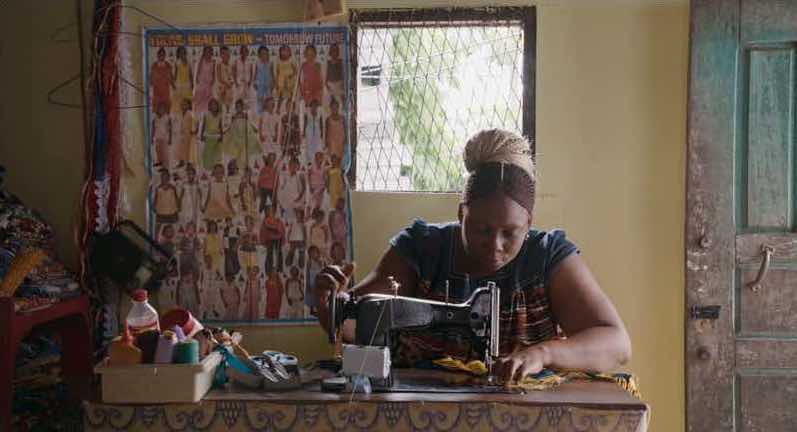
Sous la pluie de Douala, Mambar, résignée, vide l’eau rentrée dans sa maison avec l’aide de ses enfants. Arrivée dans son atelier de couture, le même calvaire recommence. À tour de rôle, les clientes défilent dans son atelier avec un seul mot à la bouche : la préparation de la rentrée scolaire. Mambar n’a encore rien acheté pour ses enfants. Ses journées sont longues, l’attente de ses enfants est grande, mais la pluie de Douala laissera-t-elle le soleil briller sur Mambar et ses enfants ? 


"Une réalisatrice qui brouille la frontière entre la fiction et le documentaire avec ce portrait sans pathos d’une mère courage qui affronte la vie avec endurance. Le film dresse un tableau subtil de la situation économique et de la place des femmes au Cameroun, portée par une formidable interprète."


***


The city of Douala is in trepidation for the start of the new school year. A long line of customers come to Mambar Pierrette, the neighbourhood dressmaker, to have their clothes ready for imminent social events and ceremonies. More than just a seamstress, Pierrette becomes the confidant of her customers, of a generation. But when the rain starts pouring down and threaten to flood her workshop - one of several successive misfortunes - Pierrette will have to stay afloat.


With this portrait, the filmmaker blurs the boundaries of fiction and documentary; without pathos a courageous mother confronts life with fortitude. The film lays out a subtle portrait of the economic situation and women’s place in Cameroon, interpreted by an impressive protagonist.


Source: https://www.film-documentaire.fr/4DACTION/w_fiche_film/68191_0


An excerpt of the interview with France 24. 24/05/2023, Text by David Rich.


France 24: "Mambar Pierrette" is your first feature film, although it features your cousin in a role very close to her reality. Where do you draw the line between documentary and fiction?


Rosine Mbakam: Pierrette's reality is at the center of the film. It was her life that inspired me to write this story. During the filming, the characters seized on the story to bring the scenario to their own reality. Fiction never takes over, it comes to densify and deepen the narrative, to contextualize certain elements. In particular, it makes it possible to clarify that Pierrette's social situation is not only linked to her husband's irresponsibility, to the fact that she does not earn enough money or to the political situation in Cameroon, but also to neocolonialism, which persists, which means that in certain countries there is still a great deal of insecurity.


France 24: The couture salon occupies a central place in the film. Why did you highlight this activity and what does it symbolize?


RM: My film tells the story of Pierrette who is a seamstress in real life. Couture embellishes, it brings people together and the couture salon is a place conducive to an atmosphere of confidentiality. I wanted to highlight the value of this work of preparing and transforming which hardly exists any more in Western society. We go shopping but we have lost this relationship, this involvement with what we wear. The couture salon also symbolizes the relationship between men and women in Cameroon. The men stay at the entrance, at the door, while the women establish themselves within, embodying the space and spread throughout. These opposing positions mark the contrast between a new generation of women who  take more and more responsibility and who want to build their own as opposed to the men who do not accept this reality and find themselves in a vulnerable situation. Pierrette doesn't sew exclusively for women, she works for everyone, it's not a space that excludes. By staying at a distance, the men protect themselves/each other, they avoid posing questions regarding their position as a means to safeguard their power.


20 March 2023

FOCUS: Thérèse Sita Bella, Safi Faye et l'évolution de la pratique cinématographique des femmes africaines | the evolution of African women’s cinematic practice - 20 - 24 / 3 / 2023 - Belgique | Belgium


FOCUS:

Thérèse Sita Bella, Safi Faye et l'évolution de la pratique cinématographique des femmes africaines  

The evolution of African women’s cinematic practice

20 - 24 / 3 / 2023 


Des femmes ont écrit une partie de notre histoire du cinéma. Des femmes encore aujourd'hui écrivent cette histoire du cinéma. Certaines sont oubliées, marginalisées et éjectées dans la transmission de cette histoire. Avec Katy Lena Ndiaye, Beti Ellerson, Mahen Bonetti.


Women participated in the creation of African cinema history and continue in increasing numbers. Though some have been forgotten, marginalized and overlooked throughout the transmission of this history.

With Katy Lena Ndiaye, Beti Ellerson, Mahen Bonetti, in person or video-conference.


20.03.2023

Pioneers and trailblazers - Thérèse Sita-Bella, Safi Faye and the evolution of African women's cinematic practice. As the programming of the Focus was already organized at the announcement of the passing of Safi Faye, a spontaneous homage was paid to Safi Faye as part of the presentation. (Beti Ellerson, Centre for the Study and Research of African Women in Cinema).


21.03.2023

The political context of the film production of pioneer African women and their invisibility in Africa and the world (Mahen Bonetti, Founder of the New York African Film Festival)


22.03.2023

Screening of En attendant les hommes and Q&A with Katy Lena Ndiaye, the filmmaker.

Interview with Chantal Ndongo, the daughter of Thérèse Sita-Bella.


Screening of selected films by Safi Faye.


Ce Focus est initié par Rosine Mbakam dans le cadre de KASK & Conservatorium / School of Arts Gent, avec la collaboration de l' INSAS,  Tândor productions, Tândor films Cameroun, IndigiMood Films, Africa Film Festival Leuven.


This Focus was initiated by Rosine Mbakam through the KASK & Conservatorium / School of Arts Gent, with the collaboration of NSAS,  Tândor productions, Tândor films Cameroun, IndigiMood Films, Africa Film Festival Leuven.


Un hommage à Safi Faye


A homage to Safi Faye

07 February 2023

Prisms And Portraits: The Films Of Rosine Mbakam

Prisms And Portraits: The Films Of Rosine Mbakam

Prisms And Portraits: The Films Of Rosine Mbakam is a collectable DVD set that contains four of her critically acclaimed, award-winning features as well as two previously unavailable shorts films. Rosine Mbakam’s powerful and empathetic documentary films focus on the migrant experiences of women and the legacies of colonialism. Cameroonian-born and Belgium-based, she constructs films with a patient rigor devoted to giving the women she features space to tell their own stories.

1. The Two Faces of a Bamiléké Woman
2. Chez Jolie Coiffure
3. Delphine's Prayers
4. Prism

https://icarusfilms.com/if-mbakam


Rosine Mfetgo Mbakam grew up in a traditional family in Cameroon. She chose cinema very early, training in Yaoundé thanks to the Italian NGO organization COE (Centro Orientamento Educativo) where, beginning in 2000 she was introduced to image making, editing and production. While there, she collaborated on and directed several films. After a meeting with Mactar Sylla in 2003, she joined the team of STV (Spectrum Television) where she directed and edited several audiovisual programmes. In 2007 she left Cameroon and enrolled at INSAS in Brussels for a training course.


With her diploma in hand, she plans her first short film, You will be my ally and co-directs a portrait of the Congolese artist Freddy Tsimba Mavambu with Mirko Popovitch for the ASBL AFRICALIA. In 2014 she founded with Geoffroy Cernaix, Tandor Productions and directed The Two Faces of a Bamileke Woman her first creative documentary released in 2017. 

02 October 2021

Rosine Mbakam: Les prières de Delphine - Delphine's Prayers

Rosine Mbakam
Les prières de Delphine | Delphine's Prayers
Cameroon
Documentary - 91 min - 2021


Description:
This film is the portrait of Delphine, a young Cameroonian girl who, after the death of her mother and the abandonment of her father’s parental responsibilities, was raped at the age of 13. She sinks into prostitution to support herself and her daughter. She ends up marrying a Belgian man who is three times her age, hoping to find a better life in Europe for her and her daughter. Seven years later, the European dream has faded and her situation has only gotten worse.

This film is the portrait of Delphine, a young Cameroonian girl. Like others, she belongs to the generation of young African women crushed by our patriarchal societies and abandoned to Western sexual colonization as her only means of survival. Through her courage and strength, she exposes these patterns of domination that continue to lock up African women.

Le portrait de Delphine, une jeune camerounaise qui après la mort de sa mère et la démission de son père de ses responsabilités parentales, subit un viol à l’âge de 13 ans. Elle sombre dans la prostitution pour subvenir à ses besoins et celui de sa fille. Elle épouse un belge qui a trois fois son âge en espérant trouver une meilleure vie en Europe pour elle et sa fille…
 

31 July 2021

Rosine Mbakam: nouvelle présidente de la commission documentaires/séries | Incoming president of the commission of documentary/series (Fonds Image de la Francophonie)

ROSINE MBAKAM
Nouvelle présidente de la commission documentaires/série
Incoming president of the commission of documentary series
(Fonds Image de la Francophonie)

La cinéaste camerounaise succède à Rahmatou Keïta, qui avait elle-même pris le relais de Marguerite Abouet en 2019.

The Cameroonian filmmaker succeeds Rahmatou Keïta, who had taken over from Marguerite Abouet in 2019.

***

Rosine Mbakam, originaire de l’Ouest du Cameroun, a suivi une première formation de réalisatrice à Yaoundé avant de rejoindre la chaîne Spectrum TV à Douala, puis d’intégrer l’INSAS, la prestigieuse école de cinéma de Bruxelles. Elle est l’auteur de plusieurs longs-métrages documentaires, dont le dernier, « Les prières de Delphine » a obtenu, cette année, le Prix des Jeunes au Festival « Cinéma du réel » de Paris. Ses trois longs-métrages documentaires sont diffusés actuellement par le MoMA (Musée d'Art Moderne de New York).

Au même moment, elle tourne, au Cameroun, le court-métrage de fiction « Pierrette », soutenu par le Fonds Image de la Francophonie.

Rosine Mbakam assurera la présidence de la commission Documentaires/séries du Fonds Image de la Francophonie jusqu’en 2023. Les autres membres actuels de la commission sont : Tella Kpomahou (Côte d’Ivoire), Emmanuel Mbédé (Cameroun), Myriam El Hajj (Liban), Delphine Manoury (France), Mamady Sidibé (Guinée) et Pierre Barrot (France, représentant l’OIF).

***

Rosine Mbakam, originally from western Cameroon, trained as a director in Yaoundé before joining the Spectrum TV channel in Douala, and afterwards INSAS, the prestigious film school in Brussels. She is the author of several feature-length documentaries. The most recent, Les prières de Delphine, won the Youth Prize at the "Cinéma du Réel" Festival (2021) in Paris. Her three feature-length documentaries are currently being broadcast by MoMA (New York Museum of Modern Art).

She is presently filming the short fiction “Pierrette” in Cameroon, which is supported by the Fonds Image de la Francophonie.

Rosine Mbakam will hold the presidency of the Documentaries / Series commission of the Image Fund of La Francophonie until 2023. The other current members of the commission are: Tella Kpomahou (
Côte d’Ivoire), Emmanuel Mbédé (Cameroon), Myriam El Hajj ( Lebanon), Delphine Manoury (France), Mamady Sidibé (Guinea) and Pierre Barrot (France, representing the OIF).

SOURCE:
https://www.imagesfrancophones.org/actualites/rosine-mbakam-nouvelle-presidente-de-la-commission-documentaires-series-du-fonds-image-de-la-francophonie

01 May 2020

African Women's Films of Women and Work

African Women's Films
of Women and Work


Safi Faye's Fad,jal : "Fad signifies “Arrive” and Jal means “Work”. “Work” because when you arrive at this farming village called Fadial, you must work. When you work, you’re happy, and if you don’t work, people will mock you". (Source: festival-cannes.com)

A selection of articles from the African Women in Cinema Blog features interviews, film synopses and descriptions, analyses and discussions regarding women's work and labor as well as explorations regarding relationships with co-workers, employers and clients. The films explore strategies for empowerment, for organizing and solidarity, as well as highlight women's experiences in non-traditional jobs, as exploited laborers and as migrant workers.

Rosine Mbakam : Chez jolie coiffure
CINEF #4 2018 - Cinéma au féminin (Kinshasa) : Ouaga Girls by/de Theresa Traoré Dahlberg

FESPACO 2019: Bibata est partie… (Bibata is gone) by/de Nana Hadiza Akawala (Niger)

Labouring Women by Tsitsi Dangarembga (Institute of Creative Arts for Progress in Africa)

Aïssata Ouarma: The Silence of Others

Theresa Traore Dahlberg and the Taxi Sister

Rahel Zegeye: The Experiences of an Ethiopian Migrant Worker and Filmmaker in Lebanon

20 February 2019

FESPACO 2019: Chez Jolie Coiffure by/de Rosine Mfetgo Mbakam (Cameroon/Cameroun)

FESPACO 2019
Chez Jolie Coiffure (2018)
by/de Rosine Mfetgo Mbakam
(Cameroon/Cameroun)

Official Selection | Sélection officielle
Hors | Out of Competition
Panorama


Synopsis

Sabine entered Belgium clandestinely. Her migratory journey began in Cameroon in the recruitment agency for a housekeeper in Lebanon. After a stay there, where she was reduced to quasi slavery, she left for Syria, then Greece, and she finally arrived in Belgium.

Sabine discovered Matongé, the African neighborhood where she can find work underground. Today, Sabine, manages the Jolie Coiffure Salon, providing work to other girls who have just arrived, until her own situation is legalized. Welcoming, smiling, happy, Sabine and the young women work 13 to 14 hours a day standing, nonstop. In this 8m2 salon, Sabine structures the workload, giving tasks to other hairdressers. At the same time, she talks with her clients, advises and finds solutions for their hair problems or even their personal problems. Furthermore, the police patrol with their dogs carry out raids in the neighborhood randomly rounding up undocumented migrants. Sabine and the other hairdressers courageously face the gaze of tourists of all ages who gawk at and photograph these women as if objects in the window—a return back to a colonial and post-colonial history.

Sabine est rentrée clandestinement en Belgique. Son parcours migratoire commence au Cameroun dans les agences de recrutement pour femme de ménage au Liban. Après un séjour au Liban où elle est réduite en quasi esclavage, elle quitte ce pays pour la Syrie, la Grèce, et enfin arrive en Belgique.

Sabine découvre le Matongé, le quartier africain où elle peut trouver du travail au noir. Aujourd’hui, gérante d'un salon «Jolie coiffure», Sabine donne du travail aux autres jeunes filles qui arrivent, en attendant que sa situation se régularise. Accueillantes, souriantes, joyeuses, Sabine et les filles travaillent 13 à 14 heures par jour debout et sans arrêt . Dans ce salon de 8m2, Sabine structure la charge de travail, done des tâches aux autres coiffeuses. En même temps, elle s'entretient avec ses clientes, conseille et trouve des solutions pour leurs problèmes de cheveux ou encore leurs problèmes plus personnels. Au même moment la police patrouille avec ses chiens et organise des descentes dans le quartier pour embarquer au hasard quelques sans-papiers. Sabine et les autres coiffeuses affronte avec courage le regard de ces touristes de tout âge qui regardent et photographient ces femmes comme des objets en vitrine et nous renvoient à toute une histoire coloniale et post-coloniale.

Biography | Biographie

Rosine Mfetgo Mbakam grew up in a traditional family in Cameroon. She chose cinema very early, training in Yaoundé thanks to the Italian NGO organization COE (Centro Orientamento Educativo) where, beginning in 2000 she was introduced to image making, editing and production. While there, she collaborated on and directed several films. After a meeting with Mactar Sylla in 2003, she joined the team of STV (Spectrum Television) where she directed and edited several audiovisual programmes. In 2007 she left Cameroon and enrolled at INSAS in Brussels for a training course.

With her diploma in hand, she plans her first short film, You will be my ally and co-directs a portrait of the Congolese artist Freddy Tsimba Mavambu with Mirko Popovitch for the ASBL AFRICALIA. In 2014 she founded with Geoffroy Cernaix, Tandor Productions and directed The Two Faces of a Bamileke Woman her first creative documentary released in 2017. 

Rosine Mfetgo Mbakam a grandi au Cameroun dans une famille traditionnelle. Elle choisit très tôt le Cinéma et se forme à Yaoundé grâce aux équipe de l’ONG italienne COE (Centro orientamento educativo) où elle est initiée à l'image, au montage et à la réalisation dès 2000.

Elle collabore et réalise plusieurs film pour cette structure avant d’intégrer en 2003, après une rencontre avec Mactar Sylla, l’équipe de STV ( Spectrum télévision) où elle réalise et monte plusieurs programmes audiovisuels. En 2007 elle quitte le Cameroun et s’inscrit à Bruxelles pour une formation à la réalisation à l’INSAS.

Son diplôme en poche, elle propose un premier CM « Tu seras mon allié » et co-réalise pour l’ ASBL AFRICALIA, avec Mirko Popovitch un portrait de l’artiste congolais Freddy Tsimba « Mavambu »
Elle fonde en 2014 avec Geoffroy Cernaix, Tandor Productions et réalise « Les Deux visages d’une femme bamileke » son premier documentaire de création sorti sur les écrans en 2017.

Source: Bande-annonce Chez jolie coiffure Screen Capture
http://www.film-documentaire.fr/4DACTION/w_fiche_film/54340_1
Image: afrikafilmfestival.be/

Bande-annonce Chez jolie coiffure from Tandor production on Vimeo.

07 July 2018

CINEF #4 2018 - Cinéma au féminin (Kinshasa) : Tu seras mon allié | You will be my ally by/de Rosine Mbakam


Court Métrage – Short
Fiction
Tu seras mon allié | You will be my ally (2012)
by/de Rosine Mbakam
(Belgique/Cameroun – Belgium/Cameroon)

SYNOPSIS

[English] 
Domé, a 35 year-old woman from Gabon, is intercepted at the airport in Brussels, as there appears to be a problem with her papers. She is subjected to a long interrogation and the immigration officer accuses her of falsification of documents. Will she achieve her goal and be allowed to enter Belgian territory?
[Français] 
Domé (35 ans), gabonaise, est interceptée à l’aéroport de Bruxelles. Il semblerait que ses papiers ne soient pas en règle. Elle est soumise a un long interrogatoire. Elle est accusée de faux et usage de faux. Arrivera-t-elle au bout de son objectif?


BIOGRAPHY | BIOGRAPHIE

[English]
Rosine Mbakam was born in Cameroon. After studying visual reporting and and audiovisual in Yaoundé from 2001 to 2004, she worked for the private channel STV (Spectrum Television) in Douala from 2004 to 2007. Rosine Mbakam enrolled at the INSAS (Institut Supérieur des Arts in based in Brussels in 2007.

[Français]
Rosine Mbakam est née au Cameroun. Après une formation en "Reporter d'images" et en audiovisuel à Yaoundé de 2001 à 2004, elle travaille pour la chaîne privée STV (Spectrum Télévision) à Douala de 2004 à 2007. Rosine Montgo Mbakam entre à l'INSAS en 2007. 

Blog Archive